
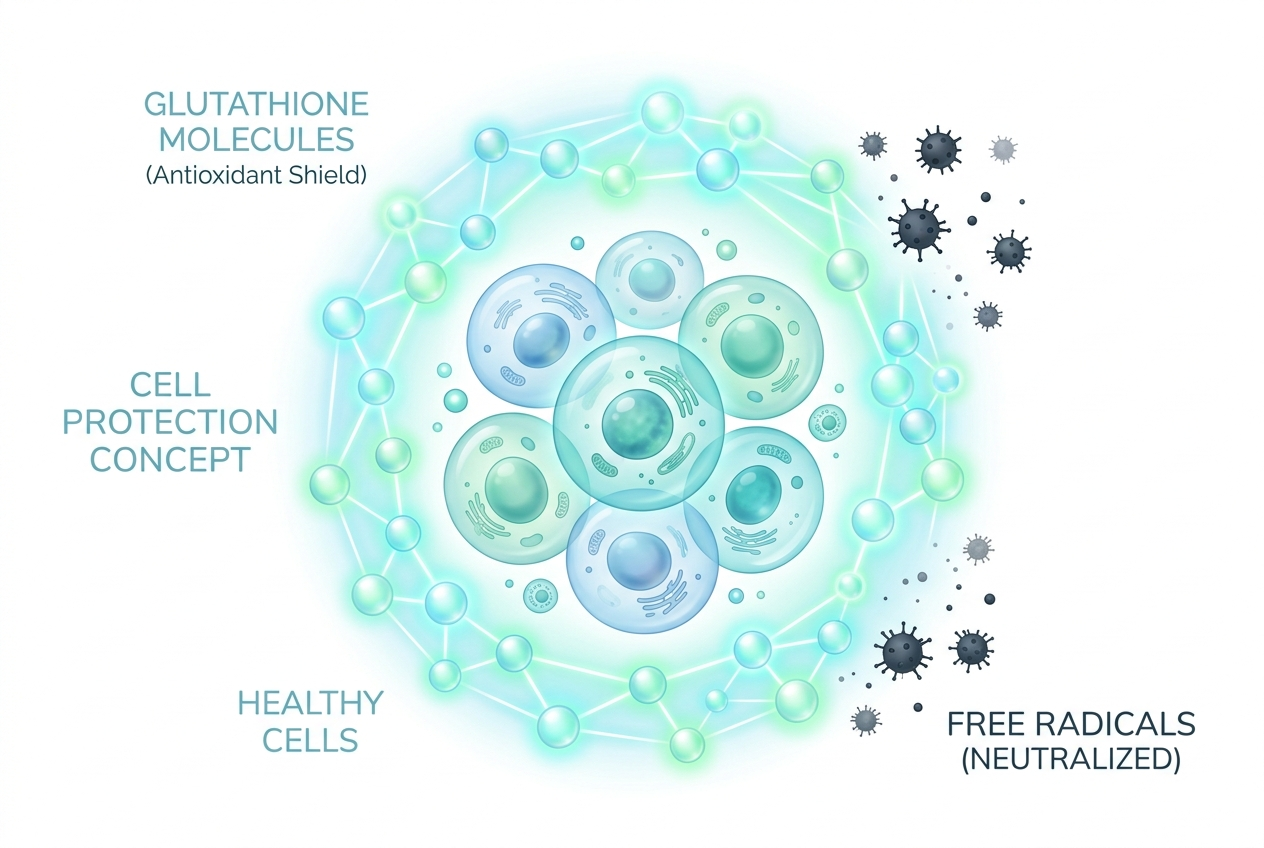
Think of glutathione as your body's internal cleanup crew, security system, and power grid all rolled into one tiny molecule. It's a short protein-like compound — called a tripeptide — made from just three amino acids: glutamate, cysteine, and glycine. What makes it extraordinary is that your body manufactures it inside every cell, not just in the bloodstream or digestive system. It is the most abundant antioxidant and major detoxification agent in cells, synthesized through a two-enzyme reaction, with its level carefully regulated in response to changes in cellular stress. Because it works from within the cell — right where damage actually happens — it can protect structures that circulating antioxidants like vitamin C simply can't reach. The body maintains glutathione in two forms: an active "reduced" form (GSH) that is ready to neutralize threats, and an oxidized form (GSSG) that has already done its job and needs to be recycled. Human studies demonstrate that an increased ratio of oxidized to reduced GSH is closely correlated with global levels of oxidative stress and inflammation — a pattern observed across metabolic syndrome, diabetes, atherosclerosis, neurodegenerative conditions such as Alzheimer's and Parkinson's disease, autoimmune diseases, cancer, and chronic infections such as HIV. In plain terms: the less active glutathione you have relative to the burned-out form, the more cellular damage is accumulating. Glutathione naturally declines with age, chronic illness, poor diet, alcohol, stress, and environmental toxin exposure — which is exactly why supplementation has become such a significant area of clinical research.
You've probably heard that antioxidants fight free radicals — unstable molecules produced by normal metabolism, pollution, UV radiation, and inflammation that can damage cells. Glutathione is the most important of these defenders, but its job is more sophisticated than simply absorbing a hit and disappearing. After it neutralizes a free radical and becomes oxidized, a recycling enzyme (glutathione reductase) restores it back to its active form so it can go to work again. This makes it a renewable resource, not a one-shot defense. During oxidative stress, GSH plays a key role of protection and detoxification as a cofactor of glutathione peroxidases and glutathione-S-transferases, and there are synergistic interactions between GSH and other components of the antioxidant defense system such as vitamin C, vitamin E, and superoxide dismutases. One of its most underappreciated jobs is reactivating other antioxidants — when vitamin C sacrifices itself to neutralize a free radical and becomes "used up," glutathione donates electrons to restore it, keeping the whole antioxidant network functioning. Glutathione also activates a genetic master switch in cells called Nrf2. Research has shown that glutathione protects against ROS-mediated DNA damage and apoptosis in part through activation of the Nrf2/HO-1 signaling pathway. Nrf2 is essentially a cellular alarm system that, when activated by glutathione, turns on hundreds of the body's own protective and detoxification genes. So glutathione doesn't just do the protective work itself — it instructs your DNA to ramp up its own defenses.
Every cell in your body contains roughly six feet of tightly coiled DNA, and every single day that DNA is bombarded by free radicals, UV radiation, toxins, and byproducts of normal metabolism. The quality of your long-term health — and your cancer risk — is heavily influenced by how well your cells detect, protect, and repair that DNA damage. Glutathione plays a direct role in all three stages. Oxidative DNA damage can lead to cancer, and as enzymatic DNA repair systems become compromised during the aging process, the role of exogenous antioxidants becomes more critical. Research has shown that the presence of reduced glutathione at physiological concentrations strongly inhibits oxidative DNA-protein cross-linking — a type of DNA damage that can cause mutations. Think of DNA-protein cross-linking like a strand of Christmas lights getting tangled and fused together — once it happens it's very difficult to fix, and glutathione intercepts the process before it gets that far. Even more importantly, glutathione doesn't just prevent new damage — it supports the repair machinery that corrects damage already done. Intracellular GSH protects cells from genotoxicity that includes inhibition of DNA damage repair; when intracellular glutathione was depleted, it markedly worsened the inhibition of nucleotide excision repair and disrupted the recruitment of repair proteins to DNA damage sites. Nucleotide excision repair is essentially your cell's editing system — it finds and cuts out damaged sections of DNA so they can be rewritten correctly. When glutathione is low, this editor loses its ability to work. Research published in Mutagenesis (2023) found that oxidative stress formed due to the immune response against SARS-CoV-2 may impair DNA repair mechanisms — a finding that connects GSH depletion during illness directly to long-term genomic vulnerability.
The liver is your body's primary filter, and glutathione is its most important chemical tool. When toxins, drugs, pollutants, heavy metals, or harmful metabolic byproducts enter your bloodstream, the liver must convert them into forms that can be safely eliminated through urine or bile. This happens in two main stages — and glutathione is central to the second stage (called Phase II detoxification), which is where most toxins are actually neutralized and packaged for removal. Phase II conjugating pathways include glucuronidation, sulfation, glutathione conjugation, acetylation, amino acid conjugation, and methylation. In the glutathione conjugation pathway specifically, an enzyme called glutathione-S-transferase acts like a molecular velcro — it attaches glutathione directly to toxic compounds, making them water-soluble and tagging them for excretion. Glutathione functions via two main detoxification mechanisms: xenobiotic detoxification through conjugation, and hydrogen peroxide reduction facilitated by glutathione peroxidase. During hydrogen peroxide reduction, GSH is converted to its oxidized form and is subsequently regenerated by glutathione reductase, maintaining cellular redox equilibrium. The liver concentrates glutathione at higher levels than virtually any other tissue precisely because of this demand — but when toxic load is heavy (from chronic alcohol use, medications, industrial chemicals, or poor air quality), the liver can burn through its glutathione reserves faster than it can make more. When that happens, Phase II detoxification slows down, toxins accumulate, and liver cells themselves begin sustaining oxidative damage.
Methylation is a fundamental biochemical process that regulates everything from how your genes are expressed to how your brain produces neurotransmitters to how efficiently you clear toxins. Think of methylation like adding a small "flag" to molecules that tells the body what to do with them. Glutathione is deeply connected to methylation through a shared biochemical pathway. The methionine cycle — which drives methylation — produces homocysteine as a byproduct. Homocysteine at high levels is toxic to blood vessels and nerve tissue, and one of the main ways the body clears it is by funneling it into a pathway called transsulfuration, which ultimately produces the cysteine needed to make glutathione. In addition to being a precursor for glutathione synthesis, methionine is also the principal methyl donor for nucleic acid, phospholipid, histone, and protein methylation; homocysteine promotes glutathione synthesis by entering the transsulfuration pathway, or is converted back to methionine by methionine synthase to complete the methionine cycle. This creates a two-way relationship: efficient methylation supplies the raw materials for glutathione production, and adequate glutathione in turn helps clear homocysteine before it becomes toxic. Vitamin B12 and folate are critical for the synthesis of S-adenosylmethionine (SAMe), a key methyl donor in numerous methylation reactions that also supports glutathione levels. For people with the common MTHFR gene variant — which impairs the folate cycle and reduces methylation efficiency — this connection matters greatly, as disrupted methylation can create a cascade that chronically depletes glutathione downstream.
Your immune cells — the soldiers that fight viruses, bacteria, and abnormal cells — work by generating controlled bursts of reactive oxygen species to destroy pathogens. But this same internal fire can damage the immune cells themselves if antioxidant defenses aren't strong enough. Glutathione is what keeps immune cells functional under that kind of stress. GSH is essential for some functions of the immune system, both innate and adaptive, including T-lymphocyte proliferation, phagocytic activity of polymorphonuclear neutrophils, dendritic cell functions, and the first step of adaptive immunity — antigen presentation by antigen-presenting cells. In simpler terms: glutathione helps T cells multiply when needed, helps neutrophils engulf and destroy bacteria, and supports dendritic cells in identifying threats and teaching other immune cells to respond to them. Natural killer (NK) cells — your body's rapid-response units that attack virally infected cells and early-stage cancer cells — are particularly dependent on glutathione. Research published in 2026 found that glutathione deficiency causes an intracellular accumulation of reactive oxygen species that impairs NK cell metabolism, accompanied by defective proliferation and cytokine production. Without adequate glutathione, these cells lose their ability to multiply and fire effectively — essentially leaving your first line of cancer and infection defense understaffed. GSH acts as an important immunomodulatory antioxidant by stabilizing redox activity, shifting the cytokine profile toward a Th1 type response, and enhancing T lymphocytes, with particular importance for patients with increased susceptibility such as those with HIV and type 2 diabetes.
If you've ever felt chronically fatigued, brain-fogged, or physically depleted despite adequate sleep, mitochondrial dysfunction driven by oxidative stress is a likely contributor — and glutathione is central to the solution. Mitochondria are the energy-producing organelles inside every cell, converting nutrients into ATP, the universal fuel your body runs on. The process that generates this energy also creates free radicals as a natural byproduct — and mitochondria are simultaneously the body's biggest energy factories and its biggest ROS producers. Mitochondria generate most of the cellular energy through oxidative phosphorylation that is essential for myriad cellular functions. Although the primary function of mitochondria is to generate ATP, a small fraction of electrons from the electron transport chain are transferred directly to oxygen, resulting in the generation of superoxide — and the steady-state concentration of superoxide in the mitochondrial matrix is 5 to 10 times higher than in the cytosol. To cope with this constant oxidative pressure, mitochondria maintain their own dedicated glutathione pool that is actively imported from the cell's cytoplasm. While synthesized exclusively in the cytosol, GSH is distributed to different compartments including the mitochondria, where its concentration in the matrix equals that of the cytosol; it plays a key role in defense against respiration-induced reactive oxygen species and in the detoxification of lipid hydroperoxides and electrophiles. Research on mitochondrial glutathione in retinal cells made the energy connection direct and quantifiable: depletion of mitochondrial glutathione resulted in reduced mitochondrial bioenergetic parameters — including basal respiration, ATP production, maximal respiration, and spare respiratory capacity — and increased cell death, revealing a critical role for mitochondrial GSH in maintaining bioenergetics and cell health. The practical takeaway is straightforward: when mitochondrial glutathione is depleted, your cells literally produce less energy and are more likely to die prematurely. Supporting glutathione levels through supplementation may help maintain the mitochondrial environment needed for sustained energy output.
For a long time, scientists were skeptical that swallowing a glutathione supplement could actually raise levels in the body. The concern was that digestive enzymes in the gut would break the tripeptide apart into its component amino acids before it could be absorbed intact. Research confirmed that standard oral GSH bioavailability is below 1% due to enzymatic degradation and poor gastrointestinal absorption. That changed with the development of more sophisticated forms. The pivotal study came from Penn State University, led by Dr. John Richie Jr., and was published in the European Journal of Nutrition (2015). This 6-month randomized, double-blind, placebo-controlled trial of oral GSH at 250 or 1,000 mg per day measured GSH levels in blood, erythrocytes, plasma, lymphocytes, and exfoliated buccal mucosal cells in healthy adults. The supplement used was Setria® Glutathione, produced by Kyowa Hakko Bio using a proprietary fermentation process. The results were definitive: for both low- and high-dose groups, glutathione levels in the blood increased after 1, 3, and 6 months compared to placebo. In the high-dose group at six months, levels increased up to 35% in erythrocytes, plasma, and lymphocytes, and 260% in buccal cells. Both groups also showed a reduction in oxidative stress as indicated by decreases in the oxidized-to-reduced glutathione ratio. This was groundbreaking because it directly contradicted the long-held assumption that oral supplementation was futile. Our Stengler Health Products use the Setria form of glutathione in our Glutathione Plus product.
Selected References
Richie JP Jr et al. European Journal of Nutrition. 2015;54(2):251–263
Nuttall SL et al. Antioxidants. 2026;15(3):354
Hristov H et al. Cureus. 2022 (PMC9616098)
Labarrere CA, Kassab GS. Frontiers in Nutrition. 2022;9:1007816
Sreekumar PG et al. Antioxidants. 2021;10(5):661
Ghezzi P. International Journal of General Medicine. 2011;4:105–113
Komaki Y, Ibuki Y. Journal of Environmental Sciences. 2022
Kankaya S et al. Mutagenesis. 2023;38(4):216–226


