
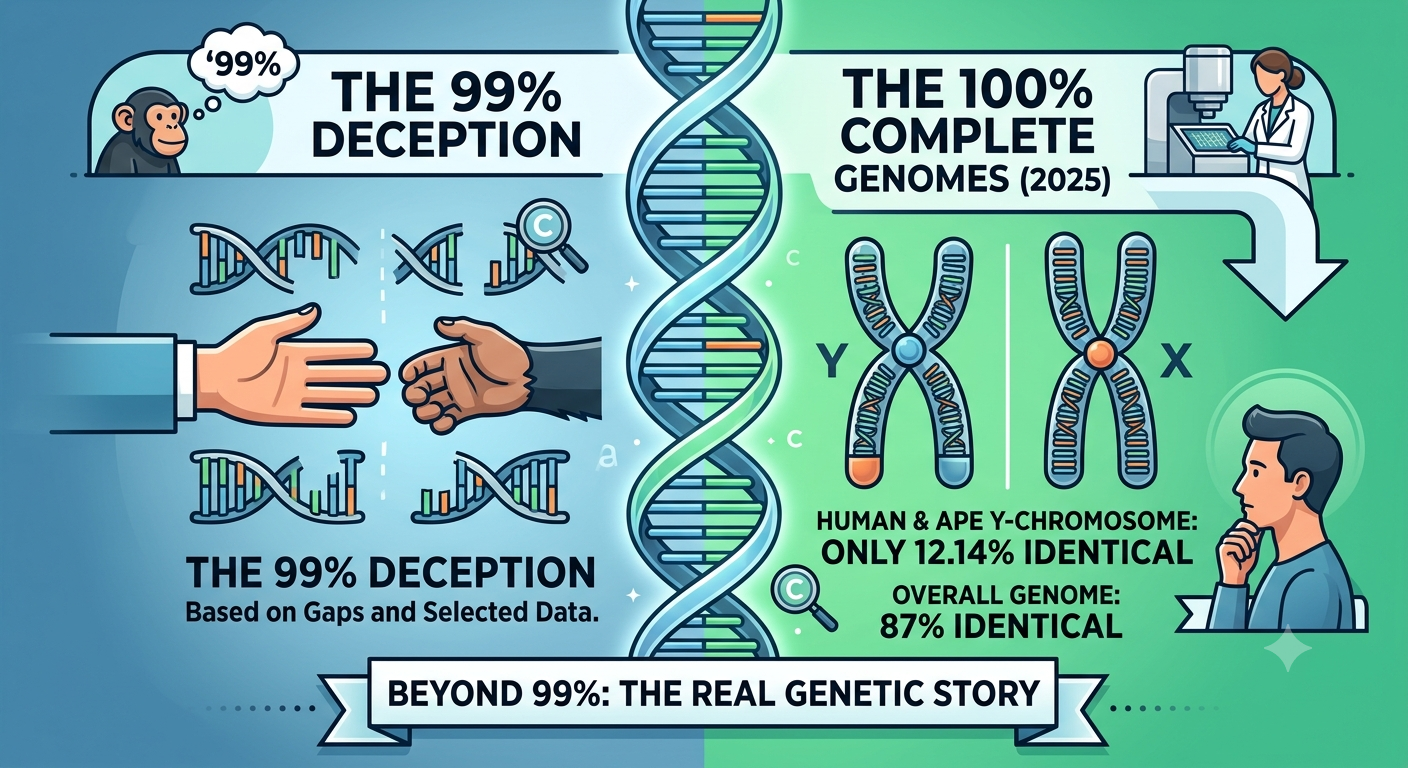
For decades, people have been told that humans and chimpanzees share “99% of their DNA,” and that this similarity is strong proof that humans and apes came from the same ancestor. But that 99% figure was always based on incomplete, gappy genome maps where researchers cherry-picked similar segments of DNA and disregarded dissimilar segments. In 2025, scientists finished something that had never been done before: they produced the first truly complete, gap-free genomes for the ape family (chimpanzees, bonobos, gorillas, and orangutans) and compared them against an equally complete human genome reference for the first time ever. When the full genomes—not just selected pieces—were lined up side by side, the overall picture changed a lot.
Comparing human to chimp identical alignment for autosomes (non-sex chromosomes) was 84.95%. For Y chromosome it was 7.75%. However, the similarity is likely even lower since there are aspects of human and chimpanzee genomes that are so dissimilar that they cannot be compared. Scientists generally say that two populations need to be about 99% to 99.5% identical to plausibly share a recent common ancestor. None of these numbers come close to that.
Here's something worth thinking about as you chew on a banana: this study, published in 2025 in the prestigious journal Nature, was the very first time anyone could do this kind of full, complete comparison of the human Y and X chromosomes against complete ape Y and X chromosomes. It was a brand-new, never-before-possible analysis that is ground-breaking. Yet the actual numbers showing how different the Y and X chromosomes are cannot be found in the main paper or its summary. Rather, they show up buried inside a separate supplementary document that runs well over 150 pages. For a result this groundbreaking and this first-of-its-kind, burying it in a supplement rather than highlighting it in the main paper is hard to understand, and frankly looks like the kind of finding that doesn't fit the expected story, so it got quietly tucked away.
This isn't the first time the Y chromosome has stood out as strangely different. Back in 2010, a separate team in the journal Nature finished sequencing the chimpanzee Y chromosome carefully enough to compare it directly with the human Y chromosome and found a dramatic difference. Some gene families found in humans don't exist at all in chimpanzees, and some chimp genes have mutations that don't exist in humans. The researchers pointed out that this gap in gene content is bigger than the gap between humans and chickens.
A different study took a step back and looked at the entire animal kingdom, not just humans and apes. Researchers gathered about five million small DNA samples (called “DNA barcodes”) from roughly 100,000 different animal species. The pattern they found held up again and again: animals within the same species cluster tightly together, with very little difference between individuals, while there's a clear, empty gap between one species and its nearest relatives—almost no “in-between” creatures exist anywhere. The researchers described species as islands sitting in empty ocean, not as points along a connected chain. Humans fit this same pattern exactly—tightly clustered among ourselves, with a clear gap separating us from chimpanzees and other apes, just like every other species studied. The same research also found that about 90% of all animal species alive today, humans included, show genetic patterns suggesting they all appeared within roughly the same window of time, not as the slow end-product of one species gradually morphing into another over millions of years. The authors of the paper, acknowledged evolutionists, stated in an interview in the mainstream publication Phys.org regarding their findings: “This conclusion is very surprising, and I fought against it as hard as I could…”
Put all of this together and a clear picture forms. The newest, most complete genetic comparisons ever done—made possible only in 2025—show humans and apes differing far more than the old “99%” figure suggested, especially on the Y and X chromosomes, and that key finding was tucked away in a supplement instead of front and center where a first-of-its-kind discovery belongs. The Y chromosomes of humans and chimps are structurally almost unrecognizable from one another. We also know that the brain's gene networks, especially in the part of the brain that makes us most human, are wired very differently between the species. And across the whole animal kingdom, species—including humans—show up as separate, tightly-bounded groups with empty gaps between them, not as gradual blends of one another. Rather than supporting the idea that humans slowly evolved from an ape-like ancestor through countless small changes, this evidence fits much better with the idea that humans and apes were never connected at all—that we are separate creations, each appearing as our own distinct kind from the start.
Hood M. 2018. Sweeping gene survey reveals new facets of evolution. Phys.org. https://phys.org/news/2018-05-gene-survey-reveals-facets-evolution.html
Hughes, J.F., Skaletsky, H., Pyntikova, T. et al. Chimpanzee and human Y chromosomes are remarkably divergent in structure and gene content. Nature, 463(7280), 536–539 (2010). https://doi.org/10.1038/nature08700
Oldham, M.C., Horvath, S., Geschwind, D.H. Conservation and evolution of gene coexpression networks in human and chimpanzee brains. Proceedings of the National Academy of Sciences, 103(47), 17973–17978 (2006). https://doi.org/10.1073/pnas.0605938103
Stoeckle, M.Y., Thaler, D.S. Why should mitochondria define species? Human Evolution, 33(1-2), 1-30 (2018). https://doi.org/10.14673/HE2018121037
Yoo, D., Rhie, A., Hebbar, P. et al. Complete sequencing of ape genomes. Nature, 641(8062), 401–418 (2025). https://doi.org/10.1038/s41586-025-08816-3 (including Supplementary Information, Section III: Genome alignment and sequence divergence)


