
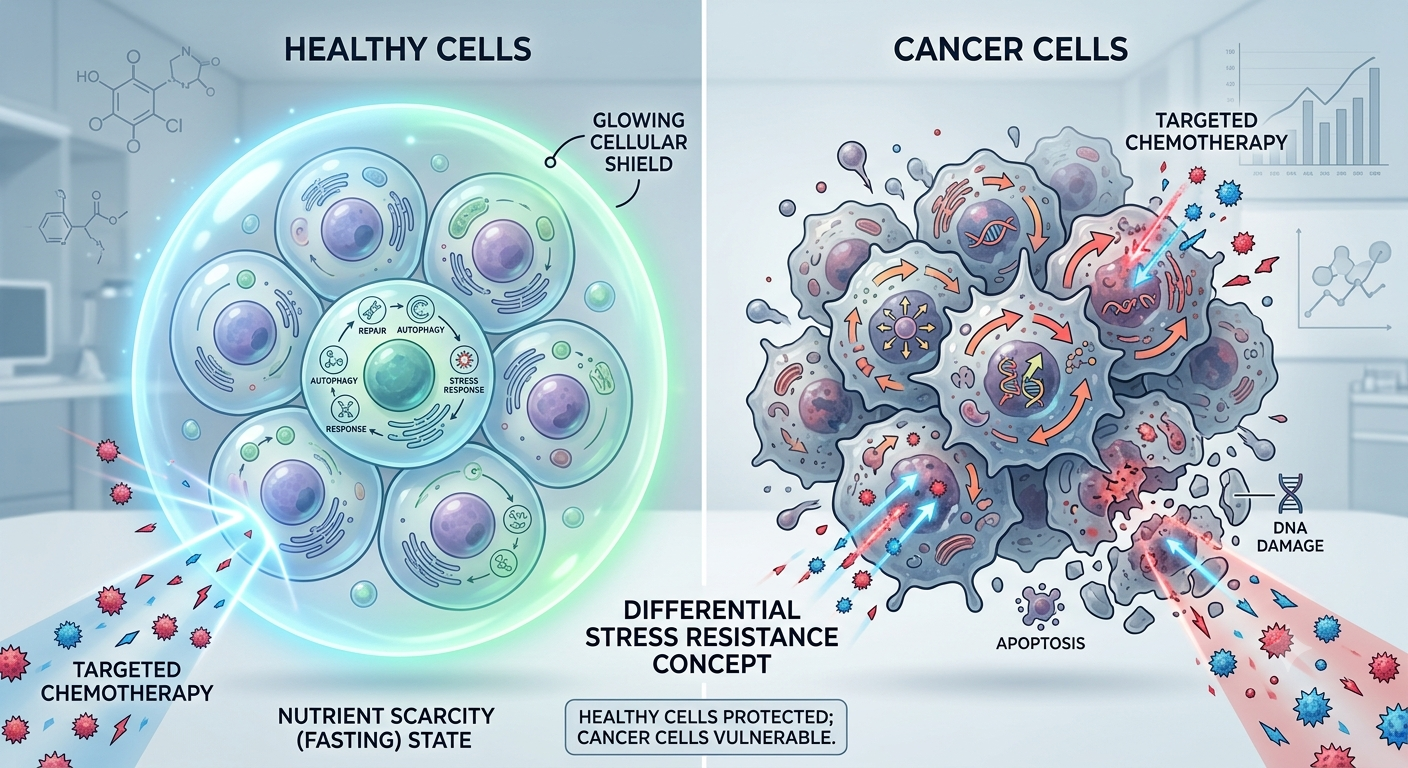
For decades, oncologists have focused primarily on which drugs to give cancer patients and at what doses. A newer area of research-at least for oncologists- asks a different question: does what a patient eats — or does not eat — in the days surrounding chemotherapy affect how well the treatment works and how sick it makes them feel? The answer, according to a growing body of clinical evidence, appears to be yes. Short-term fasting or deliberately restricting caloric intake for a defined window around chemotherapy infusions, has shown promise in reducing treatment-related side effects and, in some studies, in making tumors respond more completely to the drugs. The scientific principle behind this strategy is called "differential stress resistance." Healthy cells respond to nutrient scarcity by shifting into a protective, repair-focused state, reducing their vulnerability to the toxic effects of chemotherapy. Cancer cells, driven by overactive growth signals, cannot make this same switch and therefore remain fully exposed to the damaging effects of treatment. By essentially widening the gap between how normal cells and cancer cells respond to chemotherapy, fasting may allow the drugs to hit tumors harder while sparing the rest of the body.
Across the clinical trials conducted to date, fasting protocols have varied considerably, which makes direct comparison between studies difficult. The most studied approach, short-term fasting, typically begins 24 to 36 hours before chemotherapy is administered and continues until 24 hours after the infusion ends — a total window of roughly 48 to 72 hours. Some trials have tested even longer periods, up to 96 hours, though these are less common. In most protocols, patients are permitted to drink water freely; staying well hydrated is considered essential and is never restricted. Some trials have allowed black coffee or plain herbal tea, but caloric beverages such as juice, milk, or broth are generally excluded. A related approach gaining popularity is the fasting-mimicking diet, which is not a true water fast but rather a very low-calorie diet — typically around 600 kilocalories per day — composed mainly of plant-based soups, crackers, herbal teas, and broths specially formulated to keep the body in a fasting-like metabolic state while slightly easing hunger and discomfort. The fasting-mimicking diet begins three days before chemotherapy and continues through the day of infusion. Patients are counseled by dietitians before beginning either protocol, and fasting is not recommended for patients who are underweight, malnourished, or have uncontrolled diabetes.
The most influential clinical trial to date is the DIRECT study, a multicenter, randomized phase 2 trial conducted in the Netherlands and published in Nature Communications. This study enrolled 131 patients with early-stage breast cancer and randomly assigned them to follow either a fasting-mimicking diet or their regular diet for three days before and on the day of each chemotherapy cycle given before surgery. The results were striking: patients on the fasting-mimicking diet were significantly more likely to experience a complete or partial shrinkage of their tumor on imaging, and were nearly four times more likely to have 90 to 100 percent of their tumor cells destroyed by the time of surgery, compared with those who ate normally. The fasting group also showed significantly less chemotherapy-induced DNA damage in immune cells, suggesting the body’s defenses were better preserved during treatment. Importantly, there was no increase in serious side effects in the fasting group, even though they received less of a standard steroid used to prevent nausea than the control group. A 2024 randomized controlled trial replicated many of these findings in 44 breast cancer patients undergoing chemotherapy before surgery over eight treatment cycles. Patients on the fasting-mimicking diet had significantly lower rates of severe vomiting and dangerously low white blood cell counts, better preservation of red blood cells, lower levels of a growth hormone linked to cancer cell survival, and lower levels of a blood marker associated with inflammation. Tumor response rates also favored the fasting group.
The most recent and high-profile addition to this field was presented at the 2026 American Society of Clinical Oncology Annual Meeting in Chicago and simultaneously published in the Journal of Clinical Oncology. The study, led by Dr. Claudia Marchetti of a major university hospital in Rome, Italy, enrolled 36 women with advanced high-grade ovarian cancer — one of the most aggressive and deadly forms of gynecologic cancer, accounting for roughly three-quarters of ovarian cancer deaths in the United States. Patients were randomly assigned to either fast for 36 hours before and 24 hours after each of three chemotherapy cycles given before surgery (water was permitted throughout) or to follow their regular diet. The fasting group showed a meaningful reduction in insulin levels (insulin is known to promote tumor growth), which was the trial’s main goal, while insulin levels actually rose in the non-fasting group. Tumor response was also markedly better: nearly three in five patients in the fasting group had their cancer respond completely or near-completely before surgery, compared with a substantially lower rate in those who ate normally. Most strikingly, patients in the fasting group went roughly three years before their cancer returned or progressed, compared with approximately two years in the non-fasting group. Researchers also detected early signs that fasting favorably changed the activity of certain immune cells, potentially making the immune system better able to fight the cancer. The fasting protocol was well tolerated, and side effects were no worse than in the non-fasting group. ASCO President Dr. Eric Small of the University of California San Francisco called the findings “a great example of a very simple intervention that has benefit and can be undertaken and implemented anywhere.” The study team is now planning a larger, multicenter trial to confirm these results.
Reducing the misery of chemotherapy side effects is just as important to patients as shrinking tumors, and here too the fasting research offers encouraging data. A 2024 systematic review analyzed seven randomized controlled trials and found that fasting patients had meaningful reductions in mouth sores, headaches, muscle weakness, inflammation of the digestive lining, diarrhea, vomiting, and nausea compared with patients eating normally, as well as fewer treatment delays due to side effects. A separate 2024 review summarized evidence suggesting that fasting may also reduce unintended damage to healthy DNA and improve fatigue in certain cancer populations, though the authors noted that results across studies remain mixed and that larger trials are needed. The biological explanation for these benefits connects back to the metabolic changes fasting produces: declining blood levels of insulin, glucose, and certain growth hormones redirect the body’s energy away from cell growth and toward cellular maintenance and repair. A 2023 narrative review further described how fasting also shifts the body toward burning fat for fuel, alters how cells handle stress and damage, and may favorably influence immune cell function — all of which could contribute to a healthier experience of chemotherapy. Patients in multiple trials have also reported that fasting gave them a greater sense of agency and control over their treatment, which translated into improved emotional well-being scores.
The body of evidence on fasting around chemotherapy has grown meaningfully in recent years, but researchers and oncologists are careful to temper excitement with scientific rigor. Most trials to date have been small, have focused primarily on breast and gynecologic cancers, and have used different fasting durations and outcome measures — making it difficult to draw universal conclusions across all cancer types. A systematic review published in 2023 examined nine publications covering 379 patients and noted that while several studies showed reductions in chemotherapy toxicity and improved tolerability, most were of low to moderate quality and were not large enough to detect definitive effects on survival or remission rates. In response to the encouraging earlier breast cancer findings, Dutch researchers launched a much larger phase 3 trial now enrolling 240 patients to test whether the fasting-mimicking diet can reliably improve tumor destruction rates in hormone receptor-positive breast cancer. Additionally, a 2025 analysis of pooled data reported that fasting improved treatment effectiveness without compromising safety, though that work is still undergoing peer review. For patients interested in fasting around their chemotherapy, the current consensus among oncology researchers is that the strategy appears safe and feasible for most adults who are not underweight, but should always be done under the supervision of an oncology team and healthcare professional trained in nutrition. For more information on evidence-based medicine regarding cancer see our book Outside The Box Cancer Therapies (Hay House).
References
Bahrami, A., Haghighi, S., Moghani, M. M., Khodakarim, N., & Hejazi, E. (2024). Fasting mimicking diet during neo-adjuvant chemotherapy in breast cancer patients: a randomized controlled trial study. Frontiers in Nutrition, 11, 1483707. https://doi.org/10.3389/fnut.2024.1483707
Cancer Treatment Reviews. (2024). Intermittent fasting and its impact on toxicities, symptoms and quality of life in patients on active cancer treatment. https://doi.org/10.1016/j.ctrv.2024.102725
de Groot, S., Lugtenberg, R. T., Cohen, D., Welters, M. J. P., Ehsan, I., Vreeswijk, M. P. G., . . . Kroep, J. R. (2020). Fasting mimicking diet as an adjunct to neoadjuvant chemotherapy for breast cancer in the multicentre randomized phase 2 DIRECT trial. Nature Communications, 11, 3083. https://doi.org/10.1038/s41467-020-16138-3
Drexler, U., Dörfler, J., von Grundherr, J., Erickson, N., & Hübner, J. (2023). Fasting during cancer treatment: a systematic review. Quality of Life Research, 32(5), 1427–1446. https://doi.org/10.1007/s11136-022-03300-1
Kikomeko, J., Schutte, T., van Velzen, M. J. M., Seefat, R., & van Laarhoven, H. W. M. (2023). Short-term fasting and fasting mimicking diets combined with chemotherapy: a narrative review. Therapeutic Advances in Medical Oncology. https://doi.org/10.1177/17588359231161418
Liefers, G.-J., Schagen, S. B., Meershoek-Klein Kranenbarg, E., Veen-Lievaart, M. E., Hinnen, C., Putter, H., . . . Kroep, J. R. (2023). DIRECT2: A randomized phase III trial with a fasting mimicking diet program to improve chemotherapy in patients with hormone receptor positive, HER2-negative breast cancer. Journal of Clinical Oncology, 41(Suppl. 16), TPS630. https://doi.org/10.1200/JCO.2023.41.16_suppl.TPS630
Lugtenberg, R. T., de Groot, S., Kaptein, A. A., Fischer, M. J., Kranenbarg, E. M.-K., Carpentier, M. D., . . . Kroep, J. R. (2021). Quality of life and illness perceptions in patients with breast cancer using a fasting mimicking diet as an adjunct to neoadjuvant chemotherapy. Breast Cancer Research and Treatment, 185(3), 741–758. https://doi.org/10.1007/s10549-020-05991-x
Marchetti, C., et al. (2026). Short-term fasting during neoadjuvant chemotherapy in high-grade serous ovarian cancer: A pilot randomized trial [Abstract 5517]. Journal of Clinical Oncology, 44(Suppl. 16). Presented at the 2026 ASCO Annual Meeting, Chicago, IL, May 29–June 2, 2026.
Medeiros e Silva, F., et al. (2024). Fasting or fasting mimicking diet as a strategy for managing adverse effects in patients undergoing chemotherapy. BRASPEN Journal, 39(2), e202439117. https://doi.org/10.37111/braspenj.2024.39.1.17


