
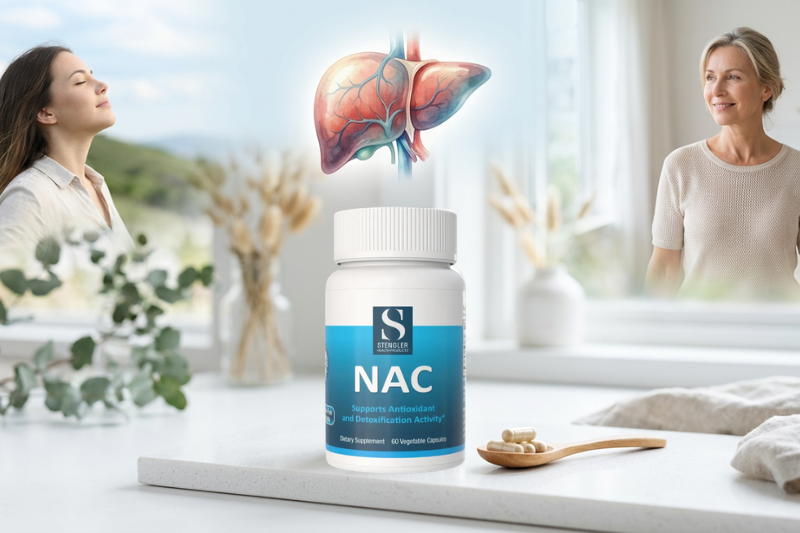
For decades, I have recommended N-acetyl-L-cysteine (NAC) to patients as one of the more versatile nutritional compounds available. NAC is a stable form of the sulfur-containing amino acid cysteine, and one of its most important functions is helping the body produce glutathione, one of our most important intracellular antioxidants. I mention the mineral sulfur since it is important for supporting detoxification.
Glutathione helps protect cells against oxidative damage and is heavily involved in the liver's natural detoxification systems. Interestingly, newer research suggests that NAC does considerably more than simply act as an “antioxidant.” A 2026 review describes NAC as a regulator of what scientists call thiol-redox biology, meaning it can influence glutathione metabolism, cellular signaling, inflammatory pathways, mitochondrial function, and even certain forms of oxidative cell injury. This helps explain why NAC has been investigated for such a wide variety of health conditions. It is also not simply a dietary supplement. NAC has been used in conventional medicine for decades, most famously as the antidote for acetaminophen overdose, where replenishing glutathione can literally protect the liver from otherwise potentially fatal damage.
One of NAC's most useful properties is its effect on the respiratory system. NAC can break chemical bonds within mucus, making thick mucus thinner and easier for the lungs and sinuses to clear. This is why I have often used it as part of an integrative approach for people dealing with excessive mucus, chronic bronchitis and other respiratory problems. The newer evidence continues to support this application. A 2024 meta- analyzed 20 studies involving people with COPD or chronic bronchitis. Compared with placebo, NAC was associated with approximately a 24% reduction in exacerbations among people with COPD and a 19% reduction among people with chronic bronchitis or pre-COPD. People with chronic bronchitis were also more likely to experience improvement in respiratory symptoms or quality of life. NAC may help the lungs through several mechanisms at the same time: thinning mucus, replenishing glutathione and influencing inflammatory signaling. Moreover, I have patients supplement NAC when they have acute and chronic sinus congestion to support mucous drainage. NAC is a supplement I recommend for immune support during the fall and winter.
NAC is equally interesting for antioxidant protection and liver support. The liver constantly processes medications, hormones, environmental chemicals and metabolic waste products, and glutathione is an essential part of many of these protective pathways. This is why I prefer to think of NAC as supporting the body's own detoxification machinery rather than as some type of vague “detox cleanse.” A 2023 systematic review and meta-analysis examined 26 controlled clinical trials and found that NAC supplementation significantly increased glutathione and overall antioxidant capacity in adults. This is important because oxidative stress occurs when the production of reactive molecules exceeds the body's ability to neutralize them, potentially damaging proteins, cell membranes, mitochondria and DNA. NAC provides cysteine that cells use to manufacture glutathione when additional cysteine is needed. Its ability to restore hepatic glutathione is also the major reason NAC became a standard medical treatment for acetaminophen poisoning. In other words, the biochemical effects of NAC are not simply theoretical—they have been demonstrated in both laboratory research and human clinical medicine.
Research has expanded into areas that many people would never associate with NAC, including brain health, mood and metabolic health. NAC affects the glutamate system in the brain as well as oxidative and inflammatory pathways, which is why researchers have examined it as an adjunctive treatment for several psychiatric conditions. A 2024 systematic review and meta-analysis involving 12 randomized trials and 904 patients with depression found that NAC produced a statistically significant improvement in depressive symptoms compared with placebo, although the overall effect was modest. The doses in these studies generally ranged from 1,000 to 3,000 mg daily, and NAC was typically used in addition to conventional treatment rather than as a replacement for it.
There is also intriguing research in women with polycystic ovary syndrome (PCOS). A 2025 meta-analysis of 22 studies involving 2,515 women reported improvements in several reproductive measures, including progesterone and endometrial thickness, although not every hormone measurement improved. These studies demonstrate an important point: NAC's potential benefits extend beyond simply “mopping up free radicals.” Its effects on glutathione, inflammation, insulin signaling, cellular redox balance and neurotransmitters may have much broader physiological implications.
For general health support, NAC is usually well tolerated, and clinical studies have commonly used oral doses ranging from approximately 600 mg to 2,400 mg daily, depending upon the condition being studied. In integrative practice, doses of 600 to 1,200 mg once or twice daily are commonly used. Our NAC is vegan derived and contains 600 mg per capsule
References
Mahmoudinezhad, M., Abbaszadeh, F., Zarezadeh, M., Bahreini, N., Jamilian, P., Jamilian, P., & Ostadrahimi, A. (2023). N-acetylcysteine, a powerful agent in the reinforcement of anti-oxidant profile: A systematic review and dose-response meta-analysis of controlled clinical trials. Clinical Nutrition ESPEN, 54, 227–238. https://doi.org/10.1016/j.clnesp.2023.01.021
Papi, A., Alfano, F., Bigoni, T., Mancini, L., Mawass, A., Baraldi, F., Aljama, C., Contoli, M., & Miravitlles, M. (2024). N-acetylcysteine treatment in chronic obstructive pulmonary disease (COPD) and chronic bronchitis/pre-COPD: Distinct meta-analyses. Archivos de Bronconeumología, 60(5), 269–278. https://doi.org/10.1016/j.arbres.2024.03.010
Peng, T.-R., Lin, H.-H., Tseng, T.-L., Huang, Y.-H., Tsai, P.-Y., Lin, C.-Y., Lee, M.-C., & Chen, S.-M. (2024). Efficacy of N-acetylcysteine for patients with depression: An updated systematic review and meta-analysis. General Hospital Psychiatry, 91, 151–159. https://doi.org/10.1016/j.genhosppsych.2024.10.018
Prescott, L. F., Park, J., Ballantyne, A., Adriaenssens, P., & Proudfoot, A. T. (1977). Treatment of paracetamol (acetaminophen) poisoning with N-acetylcysteine. The Lancet, 2(8035), 432–434. https://doi.org/10.1016/S0140-6736(77)90612-2
Qu, H.-Q., Kao, C., & Hakonarson, H. (2026). Redefining the role of the thiol-based agent N-acetylcysteine in human health and disease and elucidating potential advantages of its amide derivative. RSC Medicinal Chemistry, 17(5), 2183–2196. https://doi.org/10.1039/D5MD01173F
Santus, P., Signorello, J. C., Danzo, F., Lazzaroni, G., Saad, M., & Radovanovic, D. (2024). Anti-inflammatory and anti-oxidant properties of N-acetylcysteine: A fresh perspective. Journal of Clinical Medicine, 13(14), 4127. https://doi.org/10.3390/jcm13144127
Viña, I., Viña, J. R., Carranza, M., & Mariscal, G. (2025). Efficacy of N-acetylcysteine in polycystic ovary syndrome: Systematic review and meta-analysis. Nutrients, 17(2), 284. https://doi.org/10.3390/nu17020284


