

Microplastics are tiny plastic fragments, smaller than five millimeters, that have broken off from larger plastic items in the environment. Nanoplastics are even smaller, measuring less than one micrometer. Both are now essentially unavoidable in daily life, entering the body through drinking, eating, and breathing.
Bottled water is one of the largest contributors, since plastic bottles shed thousands of tiny particles into the liquid they hold. Plastic food packaging breaks down over time and transfers particles into food, while plastic tea bags release billions of microplastic and millions of nanoplastic particles into a single cup when steeped in hot water. Food containers and utensils shed more microplastics when heated or worn, and plastic cutting boards release tiny particles into food every time a knife scores the surface. Household dust carries plastic fibers shed from carpets, furniture, and textiles, and washing synthetic clothing such as polyester and nylon releases microfibers into water and air.
Once these particles are in the environment around you, they enter your body primarily through three routes: drinking contaminated water and beverages, eating food that has absorbed particles from packaging or utensils, and breathing in airborne fibers and dust. From there, microplastics can cross into the bloodstream and circulate to tissues throughout the body.
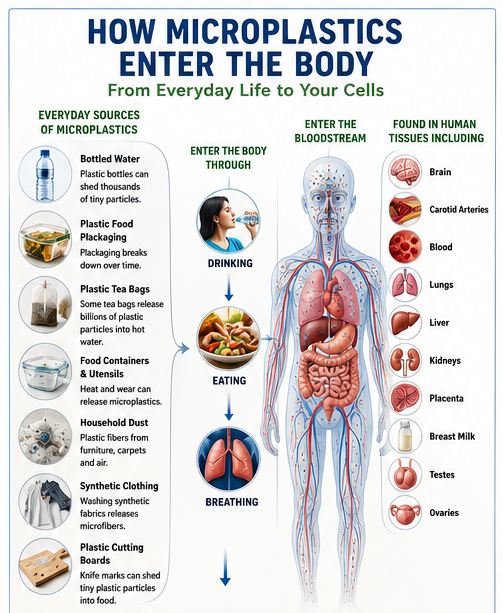
Once microplastics enter the bloodstream, they do not stay in one place. Peer-reviewed biomonitoring studies have identified microplastic and nanoplastic particles in a striking range of human tissue, including the brain, carotid arteries, blood, lungs, liver, kidneys, placenta, breast milk, testes, and ovaries. This tells us that these particles cross biological barriers that were once thought to be well protected, including the blood-brain barrier and the placental barrier.
A handful of landmark human studies have shaped what we currently know about microplastic exposure and its possible health implications:
Researchers are actively investigating a range of possible biological effects associated with microplastic exposure, including oxidative stress, chronic inflammation, immune system activation, hormone disruption, gut microbiome changes, and increased cardiovascular risk. It is important to understand that most of this evidence, aside from the Marfella cardiovascular study, comes from laboratory and animal research rather than controlled human trials. The science is real and worth taking seriously, but it is still developing.
This is probably the question I hear most often from patients: Can we remove microplastics from the body?
At this point, the honest answer is that we don’t know of any proven way to completely remove microplastics once they become lodged in human tissues. That’s an important distinction. Many websites promote “microplastic detoxes,” but there is currently no clinical evidence showing that any supplement, cleanse, juice fast, or detoxification program can pull plastic particles out of the brain, arteries, liver, or other organs.
That doesn’t mean you’re powerless. Your body has remarkable detoxification systems that continuously process and eliminate many environmental chemicals through the liver, kidneys, intestines, lungs, skin, and lymphatic system. These natural systems can remove some microplastics, particularly those that pass through the digestive tract, although scientists believe that very small particles, especially nanoplastics, may persist in tissues for much longer. Moreover, one approach is to up the fiber intake to help bind microplastics in the gut so they do not absorb, as well as promoting a healthy intestinal lining.
One of the simplest ways to support your body’s natural elimination pathways is by eating more dietary fiber. Fiber helps bind bile acids and waste products in the intestines, promoting regular bowel movements and reducing the reabsorption of certain toxins. Emerging research suggests dietary fiber may also help increase the elimination of some ingested microplastics before they can interact with the intestinal lining.
Aim for at least 25 to 35 grams of fiber daily from vegetables, fruits, beans, lentils, nuts, seeds, and whole grains if tolerated. Increase fiber gradually and drink plenty of water to avoid digestive discomfort.
Your gut microbiome plays a surprisingly important role in detoxification. Beneficial bacteria help maintain the integrity of the intestinal barrier, regulate inflammation, and produce compounds that support immune function. Animal studies suggest that microplastics may disrupt the normal balance of gut bacteria, and although human research is still developing, maintaining a healthy microbiome makes good sense.
These habits benefit digestion whether or not you’re concerned about microplastics.
Plants naturally produce compounds called polyphenols, many of which have powerful antioxidant and anti-inflammatory properties. Laboratory research suggests polyphenols may reduce some of the cellular damage caused by microplastic exposure. Excellent dietary sources include berries, green tea (preferably loose-leaf brewed in a glass or stainless-steel infuser), cocoa, olive oil, pomegranates, herbs, and spices. These foods are already associated with lower rates of cardiovascular disease and healthy aging, making them worthwhile additions to nearly every diet.
Many people assume that sweating removes microplastics. At present, there is no convincing evidence that sauna therapy eliminates stored microplastics from human tissues. That said, regular sauna use has been associated with numerous health benefits, including improved cardiovascular function, lower blood pressure, and reduced inflammation in some studies. I recommend saunas because of their overall health benefits, not because they have been proven to remove plastic particles.
One of the encouraging aspects of this topic is that many of the largest sources of exposure are completely under our control. Small changes, practiced consistently over many years, can significantly reduce your overall exposure.
Leslie, H. A., van Velzen, M. J. M., Brandsma, S. H., Vethaak, A. D., Garcia-Vallejo, J. J., & Lamoree, M. H. (2022). Discovery and quantification of plastic particle pollution in human blood. Environment International, 163, 107199. https://doi.org/10.1016/j.envint.2022.107199
Marfella, R., Prattichizzo, F., Sardu, C., Fulgenzi, G., Graciotti, L., Spadoni, T., D'Onofrio, N., Scisciola, L., La Grotta, R., Frigé, C., Pellegrini, V., Municinò, M., Siniscalchi, M., Spinetti, F., Vigliotti, G., Vecchione, C., Carrizzo, A., Accarino, G., Squillante, A., Spaziano, G., ... Paolisso, G. (2024). Microplastics and nanoplastics in atheromas and cardiovascular events. New England Journal of Medicine, 390(10), 900–910. https://doi.org/10.1056/NEJMoa2309822
Nihart, A. J., Garcia, M. A., El Hayek, E., Liu, R., Olewine, M., Kingston, J. D., Castillo, E. F., Gullapalli, R. R., Howard, T., Bleske, B., Scott, J., Gonzalez-Estrella, J., Gross, J. M., Spilde, M., Adolphi, N. L., Gallego, D. F., Jarrell, H. S., Dvorscak, G., Zuluaga-Ruiz, M. E., West, A. B., & Campen, M. J. (2025). Bioaccumulation of microplastics in decedent human brains. Nature Medicine, 31, 1114–1119. https://doi.org/10.1038/s41591-024-03453-1
Ragusa, A., Svelato, A., Santacroce, C., Catalano, P., Notarstefano, V., Carnevali, O., Papa, F., Rongioletti, M. C. A., Baiocco, F., Draghi, S., D'Amore, E., Rinaldo, D., Matta, M., & Giorgini, E. (2021). Plasticenta: First evidence of microplastics in human placenta. Environment International, 146, 106274. https://doi.org/10.1016/j.envint.2020.106274
Ragusa, A., Notarstefano, V., Svelato, A., Belloni, A., Gioacchini, G., Blondeel, C., Zucchelli, E., De Luca, C., D'Avino, S., Gulotta, A., Carnevali, O., & Giorgini, E. (2022). Raman microspectroscopy detection and characterisation of microplastics in human breastmilk. Polymers, 14(13), 2700. https://doi.org/10.3390/polym14132700
Zhao, Q., Zhu, L., Weng, J., Jin, Z., Cao, Y., Jiang, H., & Zhang, Z. (2023). Detection and characterization of microplastics in the human testis and semen. Science of the Total Environment, 877, 162713. https://doi.org/10.1016/j.scitotenv.2023.162713


