
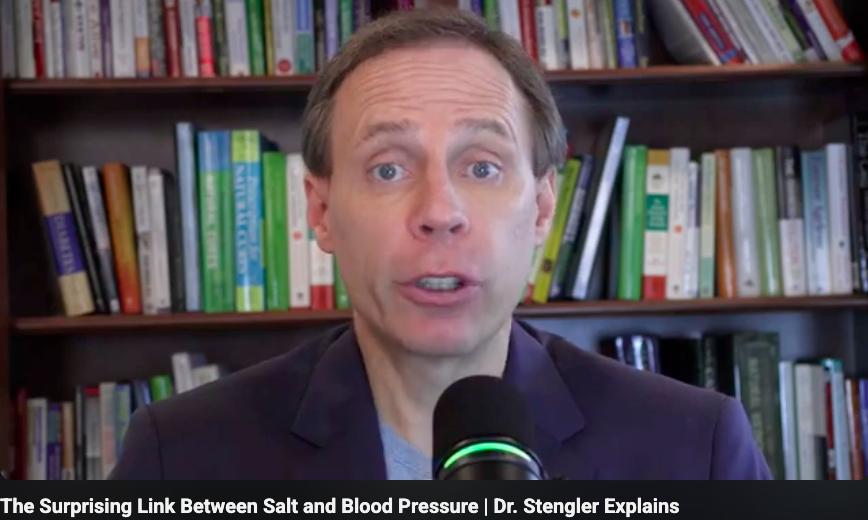

Dr. Stengler: Do you have high blood pressure and wonder how much salt affects your risk for high blood pressure? Think of salt like a magnet and water like metal shavings. With a magnet, it attracts the metal shavings in; with salt, it's drawing water in. So with high blood pressure, one of the things that can happen — if you're one of the many Americans who has too much salt in the diet, sodium and chloride, although it's mainly the sodium that's the problem — is that you're attracting water into the blood vessels, increasing that blood volume, and putting pressure inside the blood vessels. That's what high blood pressure is: that force occurring inside the blood vessels.
You may not know that nine out of 10 Americans consume too much sodium. It's recommended that people do not consume more than 2,300 milligrams a day. There are exceptions — if you're a competitive athlete, do a lot of training, sweat a lot, or work outside a lot, you need more. But for most people, they don't need more than 2,300 milligrams, and studies show that even 1,500 milligrams for a lot of people would be even better. The average American consumes 3,400 mg a day, so you really don't need more than 1,500, and most people are getting double that amount. There are also other things happening hormonally in the body — when you're getting increased pressure and increased salt, different hormonal messengers occur that lead to blood vessel constriction.
About 65% of sodium comes from packaged foods bought in stores, and about 25% comes from restaurants. Right there, that tells you something: when you're shopping, you've got to buy fresh, unprocessed foods as much as possible, and be careful eating out at restaurants, because that's 90% of your salt intake — only about 10% is from the cooking at home. With so many Americans eating processed foods and eating out so commonly, they're getting a tremendous excess in sodium.
The most recent research published in the Journal of the American Medical Association showed that a low-sodium diet of about 1,300 milligrams a day can reduce blood pressure in the majority of middle-aged to elderly adults. That's good news — just changing the sodium in the diet down to about 1,300 milligrams a day can make a big difference. In that study, there was a drop of about six points, or six millimeters of mercury, which is enough for a lot of people to get them out of the high blood pressure range. We see a lot of patients in that grade-one hypertension, the beginning stage of high blood pressure. If you want the first number, the systolic blood pressure, to be less than 130, and the second one below 90, for a lot of people who are borderline, just making that difference in sodium intake can get them out of the high blood pressure range. For people on medications, that salt reduction can make a difference between needing one medication or two or three.
There's more to the story, because in that study, the participants were given prepared meals, and in those meals they were getting 4,500 milligrams of potassium and 1,000 milligrams of calcium. We know most Americans do not consume enough potassium and calcium, and studies show both of these minerals reduce blood pressure. So it's important that you not only reduce the salt, the sodium, but that you also increase the potassium and the calcium. There are some medical conditions, like chronic kidney disease, where you've got to be careful with the amount of potassium, so if you have a medical condition, check with your doctor. But for most people, they need less sodium and more potassium and calcium.
There's been other research on salt. A very large one done in 1988, called the INTERSALT study, was unique because it involved over 10,000 men and women aged 20 to 59 from 32 different countries, including the United States and Canada. Researchers looked at the relationship between the urine excretion of electrolytes such as sodium and potassium and blood pressure, and found that high urinary sodium excretion (more sodium in the diet) and lower urinary potassium excretion (not enough potassium) were associated with high blood pressure — and even more so, the ratio between potassium and sodium was very important in predicting high blood pressure.
There's a very well-studied diet for people with high blood pressure called the DASH diet — Dietary Approaches to Stop Hypertension. In this diet, you get a diet lower in sodium and high in potassium, getting that ratio you need to help with blood pressure. It includes fruits, whole grains, fat-free or low-fat dairy products, fish, poultry, beans, and nuts, and limits foods such as fatty meats, full-fat dairy products, certain oils like palm oils, sugar-sweetened beverages, and sweets. The DASH diet is rich in potassium, calcium, and also magnesium — a great mineral for lowering blood pressure, and we know about 70% of Americans don't get enough magnesium. The DASH diet is also high in fiber and protein, so it's not going to spike insulin levels, which can also lead to high blood pressure. The average sodium intake in the DASH diet is about 2,300 milligrams, but in other studies, when you get that level down to 1,500 milligrams, the blood pressure responds even better.
As an idea of how much salt you get in a serving, a teaspoon of table salt contains about 2,300 mg of sodium. If you like to cook a lot at home — which is the best thing to do, since most people get their excess sodium from eating out or buying packaged foods — making fresh foods is the best. You can use salt substitutes that contain potassium chloride; they taste similar to salt, not exactly the same, but something people get used to. Where do people get most of their sodium? The majority comes from processed foods — deli meat sandwiches, pizza, burritos and tacos, soups, savory snacks like chips, crackers, and popcorn, poultry like chicken, pasta mixed dishes, burgers, and egg dishes, which tend to be high in sodium.
The average person can survive on 500 milligrams a day of sodium — I'm not advising a diet that low, but it shows you don't need near as much as people are getting. For potassium, adult males should get about 3,400 milligrams and females 2,600 milligrams; for calcium, adult males about 1,000 milligrams and females 1,200 milligrams. Studies show the average American adult, and child for that matter, does not meet the daily requirements for both potassium and calcium, and if you're not getting enough of these foods, it's going to contribute to your high blood pressure. So there is a connection between sodium and your blood pressure, but the more important point is lowering the sodium, the salt, in the diet while increasing the foods rich in potassium — that combination works much better than just reducing sodium by itself.
The Truth About Salt and Blood Pressure—It’s Not What You Think
You’ve heard salt is bad for your heart—but is sodium really the enemy?
In this essential video, Dr. Mark Stengler reveals the real relationship between salt and high blood pressure—and how you can naturally lower your BP without extreme diets or prescription meds.
🧂 Here's what you'll learn:
✅ How salt raises blood pressure—and when it doesn't
✅ Why the sodium-to-potassium ratio is more important than just cutting salt
✅ What real-world studies like INTERSALT and the DASH diet reveal
✅ How potassium, magnesium, and calcium can help rebalance your BP
✅ Practical swaps and food tips that work in real life
🎯 Whether you're trying to cut your meds, avoid hypertension, or just live longer—this video gives you functional medicine strategies backed by real science.
👉 Watch now and take the pressure off your heart—naturally.
🔔𝐃𝐨𝐧'𝐭 𝐟𝐨𝐫𝐠𝐞𝐭 𝐭𝐨 𝐬𝐮𝐛𝐬𝐜𝐫𝐢𝐛𝐞 𝐭𝐨 𝐦𝐲 𝐜𝐡𝐚𝐧𝐧𝐞𝐥 𝐟𝐨𝐫 𝐦𝐨𝐫𝐞 𝐮𝐩𝐝𝐚𝐭𝐞𝐬.
🔗 Stay Connected With Me.
Facebook: / markstengler Instagram: / markstengler Website: http://drstengler.com/


