
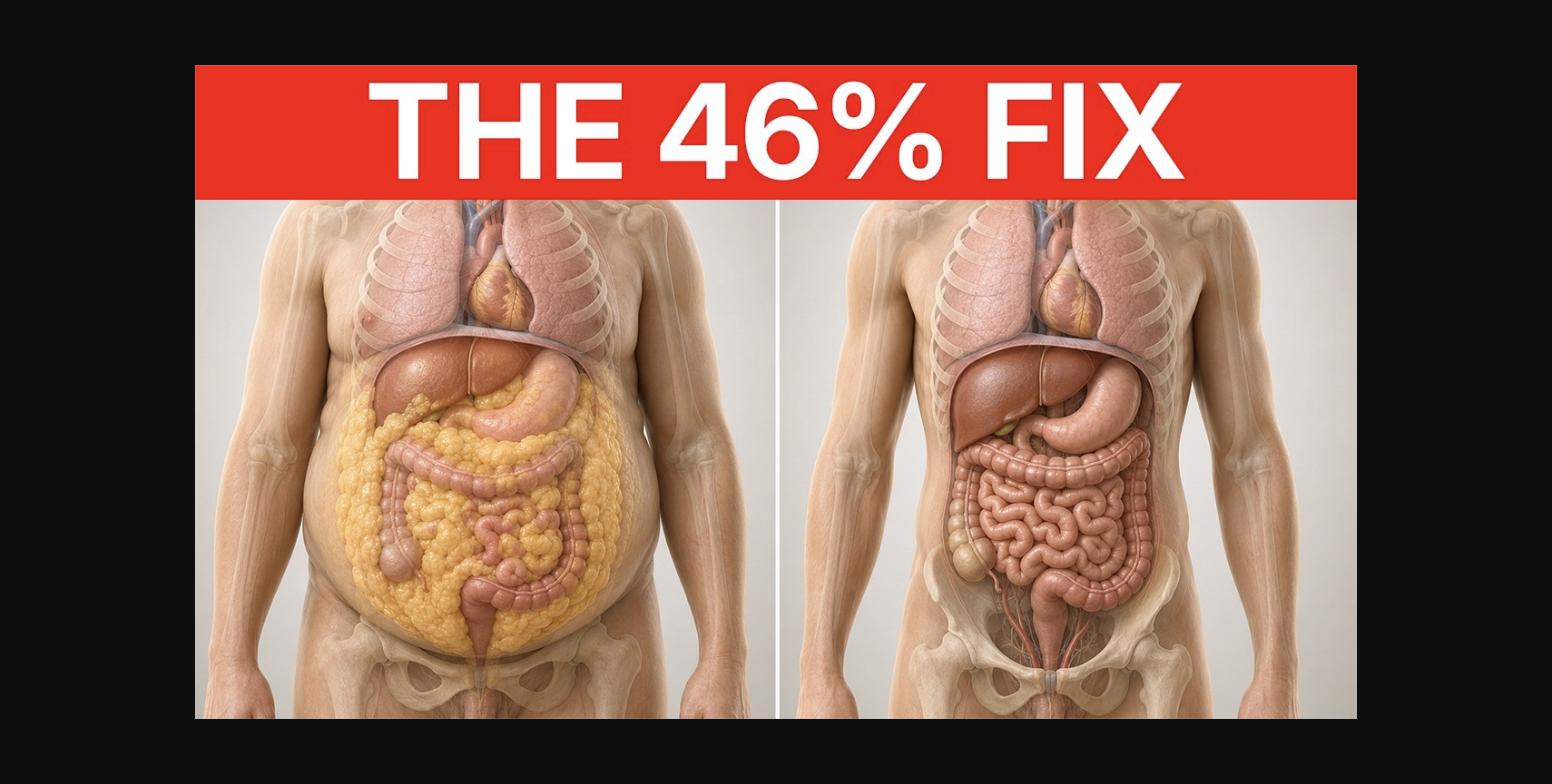

If you've been trying to lose that stubborn fat around your stomach and nothing seems to work, no matter how little you eat or how hard you exercise, I want you to stick with me for the next few minutes because I'm going to explain why that's happening and exactly what to do about it. But before we get into the plan, I need you to understand something important. Belly fat is not just a cosmetic problem. It's not just about how your clothes fit or how you look in the mirror. The fat that collects around your stomach and waistline is metabolically active tissue. It behaves almost like an organ of its own and it's directly linked to some of the most dangerous conditions in modern medicine. That abdominal fat releases inflammatory compounds and free fatty acids directly into your bloodstream and liver. And research published in the Journal of Hypertension has shown that this pattern of fat accumulation is strongly tied to insulin resistance and to an atherogenic, meaning artery damaging, cholesterol pattern. Other research has connected excess abdominal fat to higher rates of type 2 diabetes, coronary heart disease, blood clots, and other conditions such as kidney damage. So when I talk about losing belly fat today, understand that we're not just chasing a look in the mirror, although that can be important too. We're addressing one of the most important drivers of chronic disease in your body. And at the center of almost all of it is one hormone, insulin. Today I'm going to walk you through the exact integrative approach I use with my patients to lower insulin, shrink that abdominal fat, and do it in a way that's sustainable. Not a crash diet, but a real metabolic reset. We'll cover what to eat, when to eat, how to exercise, why sleep matters more than you think, how to actually track your progress using your waist, and even a continuous glucose monitor, and the specific supplements with real clinical research behind them for insulin resistance. Let's get into it. Here's the piece that most weight loss advice gets wrong. It treats all calories the same. But your body doesn't respond to all foods the same way. When you eat something that spikes your blood sugar quickly, your glucose levels, your pancreas releases a surge of insulin to bring that sugar down. That's insulin's job, amongst other things, is to tell your fat cells to store energy. So, every time you spike your blood sugar, you're sending a storage signal to your body, and a disproportionate amount of that storage tends to happen right around your midsection. Over time, if your cells are bombarded with insulin again and again, they start to become resistant to it, meaning your pancreas has to produce even more insulin to get the same effect. This is insulin resistance, and it creates a vicious cycle. Higher insulin drives more fat storage around your stomach and abdomen, and more abdominal fat worsens insulin resistance, and so on. This is exactly why the strategy I'm about to walk you through isn't a generic eat less, move more plan like you hear from many doctors. Every single piece of it, the food choices, the timing, the exercise, the sleep, the tracking tools, the supplements, is specifically chosen because of its effect on insulin. Hey everybody, I want to take just a quick moment and invite you to my website, Dr. Stengler. com. Here we have the supplements that we've been using with our patients for many, many years. High-quality and high-potency supplements, very pure. So, if you're looking for high-quality supplements where you can notice a difference both in how you feel on your lab test, go to our website at drstengler.com. Let's start with the food. So, the first strategy is low-glycemic foods. The first pillar in choosing foods that don't spike your blood sugar, what we call low-glycemic index foods, is extremely important. Things starch vegetables, legumes, most fruits, and whole intact grains rather than refined ones. This isn't just a theory. A systematic review and meta-analysis of randomized controlled trials published in Frontiers Nutrition looked specifically at adults without diabetes and found that low-glycemic index diets produce a significantly greater reduction in insulin resistance compared to, of course, high-glycemic index diets. In other words, this isn't just about avoiding sugar spikes in the moment. Sustained low-glycemic eating measurably improves how sensitive your cells are to insulin. Second, you need a high-fiber diet. And this is one of my favorite tools clinically. Fiber, and specifically eating fiber first at every meal, and this is why the order matters. Research on dietary fiber and glycemic response has shown that soluble fiber slows gastric emptying and increases the viscosity of food in your stomach, which blends how quickly glucose hits your bloodstream. In one study, a fiber preload before a meal reduced the post-meal insulin spike by 46% compared to the same meal without that fiber preload. Other research examining soluble and insoluble fiber ratios in overweight women found that a fiber preload significantly lowers insulin and the hunger-related hormone known as CCK after eating. Meaning that fiber doesn't just blunt the insulin spike, it also makes you feel fuller and you naturally eat less at each meal. So, my advice is start your meal plate with a salad, for example, steamed vegetables, or if you need to, a fiber supplement. You'll eat less, and what you do eat will not spike your insulin as much. Moderate protein is also important. Not excessive, not minimal, protein in each meal. Protein helps to preserve lean muscle mass while you're losing fat. And muscle is metabolically active tissue that helps to improve insulin sensitivity over the long term. It also has a much smaller effect on blood sugar than refined carbohydrates, and it adds that feeling of satiety we just talked about with fiber. And the fourth thing is do not eat after 7:00 p.m. This is rooted in the science of early time-restricted eating. In a landmark study published in Cell Metabolism, men with prediabetes were randomized either an early time-restricted feeding schedule where all meals were finished by 3:00 p.m. or a control schedule with a standard 12-hour eating window. And importantly, both groups maintained their weight, so any benefits couldn't be explained by weight loss alone. The early time-restricted group showed improved insulin sensitivity, improved beta cell responsiveness, meaning the cells in the pancreas that produce insulin work better. There's also lower blood pressure and reduced oxidative stress. While many people can't stop eating at 3:00 p.m. because of activity, the earlier the better. And there's been other studies have shown that insulin sensitivity is improved when you finish your last meal of the day early or that you don't eat late at night. And this helps your body to follow a natural circadian rhythm where it's better to eat earlier in the day and avoid eating late. And that will have a better effect metabolically working with your body's chronobiology or your circadian rhythm. A 7:00 p.m. cutoff isn't arbitrary. It gives your body several hours of fasting before sleep when insulin sensitivity is already declining for the day. Now, let's talk about something most weight loss programs ignore completely and that's sleep. This is not a minor lifestyle suggestion. Sleep is one of the most powerful levers you have over insulin sensitivity and the research on it is striking. In a controlled study published in the journal Diabetes, healthy men who were restricted to just 5 hours of sleep per night for 1 week saw their insulin sensitivity, measured by the gold standard clamp technique, drop by over 11% and by 20% using a separate glucose tolerance measurement. This happened in healthy people with no prior metabolic problems in just 7 days. Beyond the direct effect on insulin, insufficient sleep disrupts the two hormones that regulate hunger and fullness. Ghrelin, which increases appetite, and leptin, which signals satiety. When sleep is short, ghrelin rises and leptin falls, which means you feel hungrier and less satisfied, and you're more likely to crave high-calorie, high-carbohydrate foods. Insufficient sleep also raises cortisol, your primary stress hormone, and a chronically elevated cortisol is specifically linked to increased fat storage around the abdomen. A large study of almost 22,000 adults over 8 years found that people sleeping 6 hours or less had a significantly higher risk of major weight gain compared to those sleeping 7 hours. And a more recent analysis identified roughly 7 and 1/2 hours is that sweet spot for insulin sensitivity. Interestingly, that study found that more isn't necessarily better either. Sleeping well past the amount of time that you need could actually worsen insulin sensitivity. So again, shoot for about that 7 to 7 and 1/2 hours of sleep a night to help improve your metabolism. Now to exercise and specifically, why I want you doing high-intensity interval training or hit training three times a week rather than just steady moderate cardio. A systematic review of randomized controlled trials specifically measured abdominal fat with imaging and they found that four out of five trials report significant reductions in abdominal fat after just eight to 12 weeks of hit training performed three times weekly. And notably, every single hit intervention in that review produced significant reductions in hemoglobin A1C, which reflects your average blood sugar control over the prior 3 months. In a study specifically in older adults, an average age of 63, just 6 weeks of hit training or three sessions a week improved whole body insulin sensitivity measured with a certain technique and reduced abdominal fat mass and total body fat percentage. It also works in sedentary older adults in just 6 weeks of time. And so there's no reason why it can't work for you. What makes hit particularly valuable is the time efficiency combined with a strong insulin sensitizing effect. One trial comparing hit to moderate-intensity continuous training in people who are overweight or obese found that hit produced a greater reduction in waist circumference and a stronger trend towards decreased insulin resistance despite a shorter total training time. I want to be balanced with you though. The research is mixed on whether hit clearly outperforms moderate cardio for every single outcome. And some studies show comparable benefits between the two. But given that hit consistently shows strong insulin and abdominal fat benefits in a fraction of the time, it's the more efficient choice for most of my patients. Three sessions a week, that's all you need. You don't have to live in the gym. One of the simplest and most powerful tools you have to track your progress is a tape measure around your waist. I want you measuring once a week, not daily, since daily fluctuations from water retention and digestion will only frustrate you. Once a week, same day, same time, ideally first thing in the morning before you've eaten. Here's how to do it correctly based on the World Health Organization protocol. Stand up straight and find the midpoint between the bottom of your lowest rib and the top of your hip bone, the iliac crest. That's usually right around or just above your belly button. Wrap the tape around your body at that point, parallel to the floor, all the way around. The tape should sit snugly against your skin without compressing it, not pulled tight enough to dig in. Take the measurement at the end of a normal exhale, not after sucking in your stomach. Write the number down so you have a consistent record week to week. Now, what's a healthy number to aim for? Well, according to the WHO, commonly used thresholds include a waist circumference below 40 inches or 102 centimeters for men and below 35 inches or 88 centimeters for women. Other major health bodies use a slightly stricter cutoff below 37 inches for men and below or about 31 and 1/2 inches for women as the optimal healthy range. One more useful rule of thumb, if you want a number that adjusts for your height, keep your waist circumference under half your height. So, if you're 5'8", that's about 68 inches, your waist should ideally stay under 34 inches. This single number is one of the best, free, simple tools you have to track whether your plan is working. It's independent of what your scale says. The next test I want you to consider using is the continuous glucose monitor, and you've seen those advertised on TV. These are small sensors, usually worn on the back of your arm. They can now get without a prescription in many cases, including devices like the Freestyle Libre and Dexcom Stelo. The sensor sits just under the skin and measures the glucose in the fluid surrounding your cells continuously, sending a reading to an app on your phone every few minutes all day and all night. Traditionally, these were only used with people who had diabetes, but now they're very popular for people who are trying to manage pre-diabetes and to manage their weight. So, what the research shows is that a continuous glucose monitor helps you to track, to lower, and stabilize your blood glucose averages, largely because it changes your behavior in real time. You can literally watch what a piece of bread or sugary coffee does to your blood sugar, and that feedback tends to change what you choose to eat next. So, I found it to be very motivating for my patients. The direct evidence connecting The continuous glucose monitor becomes your real-time feedback loop, and your weekly waist tape becomes your outcome measure. Track both, and you'll start to see the pattern for yourself. If you decide to try a continuous glucose monitor, here's how to use it. Wear for at least 1 to 2 weeks, and pay attention to two things in your app: your average glucose number, and how high your glucose spikes after meals. Then start experimenting. Try a meal with fiber first versus without it. Try eating dinner at 7:00 p.m. versus 9:00 p.m. Try a walk after a meal versus sitting. You'll start to see in your own data exactly which of these strategies moves the needle most for your body. Now, let's talk about the supplements that target insulin resistance. The supplement I get asked most about more than almost any other right now is berberine, and the research genuinely backs the interest. A meta-analysis of 46 randomized control trials involving over 4,100 participants found that berberine significantly reduced fasting blood glucose levels, post-meal glucose levels, and hemoglobin A1C. More importantly for our topic today, it significantly improves every marker of insulin resistance. There's a few different ones that can be tracked by doctors. In trials, berberine has been compared to the pharmaceutical metformin, the diabetes drug. The two performed comparably for blood sugar control. So, the clinical evidence behind berberine is some of the strongest of any natural compound we have for lowering and improving insulin resistance. Typically, clinically studied doses range from 900 to 1,500 mg daily divided across meals. I use a highly absorbable form of berberine known as berberine phytosome. Also, let's talk about psyllium and glucomannan. This is my second category, supplemental fiber. For the times that you can't get a full fiber preload from whole foods alone. We already discussed the mechanism that fiber gives you in terms of slowing gastric emptying and making you feel more full and reducing blood sugar spikes. A review of soluble dietary fiber research highlighted that glucomannan and psyllium are among the most well-studied viscous fibers for this exact purpose, along oat beta-glucan. In clinical trials, even moderate daily doses of soluble fiber in ranges of 10 to 20 g a day produced significant improvements on blood glucose, insulin resistance, and overall metabolic profile in patients with type 2 diabetes. But, this can work well even for people who do not have diabetes. So, my advice, take a psyllium or glucomannan supplement with a full glass of water around 15 to 20 minutes before your largest meals of the day. This does two things simultaneously. It blunts the glucose and insulin spike from the meal that follows, and it fills stomach volume so you naturally eat less. This is the supplement version of the fiber first strategy we talked about earlier for the days when whole food fiber isn't practical. Let's recap the plan because I want you to leave this video with something you can actually start today. Build your meals around a low-glycemic food diet. Start every meal with fiber, whole food or a psyllium or glucomannan supplement to blunt your glucose and insulin response and naturally eat less. Include a moderate portion of protein at each meal. Stop eating by 7:00 p.m. to align with your body's natural insulin sensitivity rhythm. Protect a minimum of 7 hours of quality sleep every night. This is not optional. Do hit training three times a week for a time efficient powerful tool against abdominal fat and insulin resistance. Measure your waist once a week using a proper technique aiming below roughly 40 inches for men and 35 inches for women or under half your height. Consider a continuous glucose monitor as a feedback tool to see how your choices affect your glucose in real time and consider berberine along with a fiber supplement for more effective clinically supportive tools. None of these pillars work as well in isolation as they do together. So, this is a systems approach because insulin resistance is a systems problem. It touches what you eat, when you eat, how you move, and how you sleep. It addresses all of it. Well, I hope you like this video. If you did, hit the like button and make sure you subscribe this channel as we have many more videos coming out on integrative health and medicine. >> [music]
Stubborn belly fat is not just a cosmetic issue. It is one of the strongest drivers of insulin resistance, type 2 diabetes, and heart disease.In this video, Dr. Mark Stengler walks you through the real cause of abdominal fat, how to lower insulin with the right foods, meal timing, sleep, and HIIT training, plus the supplements with strong clinical research behind them for insulin resistance and metabolic health.Chapters:00:00 Why Belly Fat Is More Than Cosmetic01:41 How Insulin Drives Belly Fat03:08 Low Glycemic Foods and Fiber First04:50 Protein and Early Time Restricted Eating06:26 Why Sleep Controls Insulin Sensitivity08:00 HIIT Training for Abdominal Fat09:42 How to Measure Your Waist Correctly11:13 Using a Continuous Glucose Monitor12:46 Best Supplements for Insulin Resistance14:54 Final Belly Fat Action PlanVisit Dr. Stengler's Website: https://drstengler.com/


