
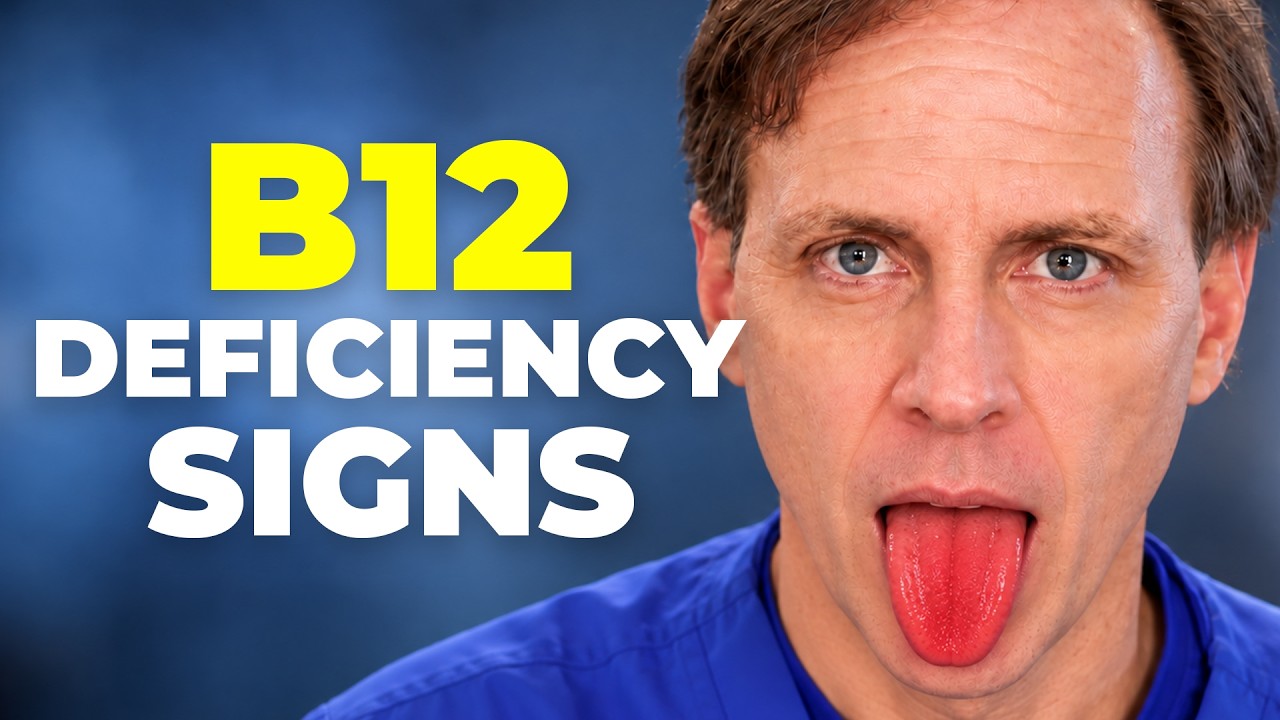

You eat meat, you take a multivitamin, and your last blood count looked normal. So, could you still have a B12 problem? Yes, because getting B12 into your diet and getting enough into your body are different things, and nerve symptoms can occur without anemia. Let's look at the five changes that deserve your attention regarding B12 deficiency and how to find out what they mean. I want you to recognize a possible treatable reason you're feeling unlike yourself so you can take the right next step towards better energy and function instead of guessing which supplements to buy. Hi, I'm Dr. Mark Stangler and my focus is integrative medicine, including how nutrition and digestive health affect the rest of the body. Now, in this video, we'll cover the five signs and symptoms of B12 deficiency and why a good diet doesn't always prevent a deficiency and which tests can help clarify the picture. Then we'll talk about treatment and what to do first. These signs and symptoms are reasons to investigate, not a way to diagnose yourself. Number one, fatigue that changes what you can do. You see, B12 deficiency can interfere with healthy red cell production and contribute to fatigue. A persistent change in ordinary activity is worth describing and looking at, but fatigue alone cannot identify the cause. So, we want to connect how B12 affects oxygen delivery. And the way we do that is looking at the fact that bone marrow produces blood cells and B12 supports DNA production needed for developing cells to divide normally. Now B12 deficiency can leave too few healthy red blood cells. And because these cells carry oxygen, anemia causes weakness, fatigue, and breathlessness because you can't get enough oxygen into your cells. So for some people, you're doing everyday activities you normally do, your normal walk, and it takes more effort than before. or you walk upstairs and you're having shortness of breath. So, all sorts of different symptoms can occur when you have anemia, that's related to B12 deficiency. Now, not every tired person has low B12 and B12 deficiency does not always cause anemia. You see, B12 also supports the nervous system. That leads to signs of a normal blood count on blood tests, but it can still cause neurological problems. Tingling or numbness in your hands or feet are signs of B12 deficiency. Because B12 deficiency causes abnormal nerve signaling and you get abnormal sensations in your nerves. Again, even when you're not anemic and you might have even more serious types of symptoms, even thinking it's something like a stroke going on. Peripheral nerves carry information between the body and the brain, including touch and sensation in the feet. And the way it works is that B12 supports myelin. This is the protective covering around many nerve fibers that helps signals travel properly along the nerves. A deficiency causes tingling or numbness. And again, it could be something beyond B12 deficiency when you have numbness and tingling. So just because you're not anemic doesn't mean there's not a problem with B12 because we know neurological symptoms can occur even when you don't have anemia. So number three, let's talk about more neurological symptoms. New ongoing or worsening tingling is one of the primary symptoms of B12 deficiency. Usually when it's becoming a lot more severe, not just a mild case. And again, you can have problems with balance or even walking because walking depends on sensory feedback as well as the muscles being related to the nerve function. So these types of symptoms neurologically could be related to B12 deficiency. And of course, the nerves tell the brain where your your limbs are, your hands and your feet, and helping to coordinate movement. Hey, one second. If you're looking for help with any type of health issue, I put together a line of doctor grade supplements that I formulated myself. They're the same formulas I use with my patients. Click the link below to check them out. Okay, back to the video. Now, let's look at a change you might notice in your memory or concentration because this is sign number four. a noticeable change in memory or again your concentration. B12 deficiency can be very relevant to a persistent change in thinking and mood for that matter that makes it possible to investigate looking at possible causes again like B12 deficiency. And so people with B12 deficiency often note that they have problems with concentration. It's more difficult. They can have slower thinking and unusual forgetfulness. This is especially common in seniors. Some studies show about 25% of seniors have B12 deficiency. Now let's look at science symptom number five and that is a sore, smooth or unusually red tongue and this is known as glossitis. It's a fancy term just means inflammation of the tongue and that can be caused by deficient B12. So whenever you have persistent soreness or swelling of the tongue obviously you need to have an examination and glossitis that diagnosis should be then examined in terms of B12 deficiency and people with these symptoms often have irritation feel like their mouth or their tongue is infected and so we want to look at B12 deficiency amongst other causes for this condition. So in summary B12 deficiency has a variety of different presentations. I mentioned five of the more common presentations. And so remember, you don't have to have all five of them. You may just have one of them. And so if you have one, two, three, four, or five, you should investigate to see if B12 deficiency is a problem. Now, I should note that eating B12 in your diet does not always mean that you're absorbing it. Perhaps you eat meat, fish, eggs, and dairy, which have good sources of B12, but that doesn't mean you're absorbing it. If you're a person who's more vegan or vegetarian and you're not getting enough B12 in your diet because vegetables alone often don't guarantee sufficient levels, you have to consider B12 deficiency. So, you need stomach acid, digestive enzymes uh to help break down foods that release to B12. We have something called intrinsic factor we need to absorb B12 as well. And some people have conditions that interfere with absorption. Let's talk about some of those conditions. know certain stomach conditions that reduce stomach acid or intrinsic factor that can be autoimmune problems right in the lining of the stomach for example so you're not producing that intrinsic factor needed to absorb B12 in the small intestine a long-term acid suppression with the medications like the proton pump inhibitors people use for acid reflux and gird can be an issue metformin is known to cause B12 deficiency over time that's a common drug used for pre-diabetes and type 2 diabetes so if you're on that medication You should keep an eye on your B12 level. Alcohol depletes you of a lot of the B vitamins, especially B12. Now, let's talk about tests regarding B12 deficiency. And most doctors are obviously aware that you can measure B12 in your blood levels, but there can be different ranges. Uh just low levels of B12, not deficient, could still cause symptoms. There's also another test called methylalonic acid, and it's produced during metabolism and processing the B12. And so if B12 levels are sufficient, high levels of MMA or methylamalonic acid can show up in a test and some people consider it to be a much more sensitive test of B12 deficiency. Now, of course, in our diet, we always want to try and get reliable B12 food sources, but for some people, that's not going to work for a variety of reasons I mentioned earlier. And so, we can use injectable B12 that can work good. Sublingual B12 goes right into the bloodstream. Uh, that can be very good as well. And there's many different forms of B12. I avoid the older form of B12 and had for many decades known as cyanocobalamin. Instead, I mainly use the more natural form known as methylcobalamin. And that's a good genetic match for most people as it's involved in methylation processes. And so for most of my products, you'll see at drstangler.com, we use methylcobalin, but there are other good natural sources as well. So now you know the five main signs and symptoms of B12 deficiency. If you have any of these, you should consider taking B12 or at least get your levels tested to see if you have a problem with B12 deficiency. Well, if you like this video, hit the like button. If you haven't subscribed, make sure you subscribe to the channel and I look forward to talking to you about another health topic in a future video.
B12 deficiency is one of the most commonly missed causes of fatigue, nerve problems, brain fog, and more. In this video, I walk through the 5 warning signs of B12 deficiency you should never ignore, why your diet alone may not be enough, which medications and conditions interfere with B12 absorption, and the best forms and tests to make sure your levels are where they need to be.


