
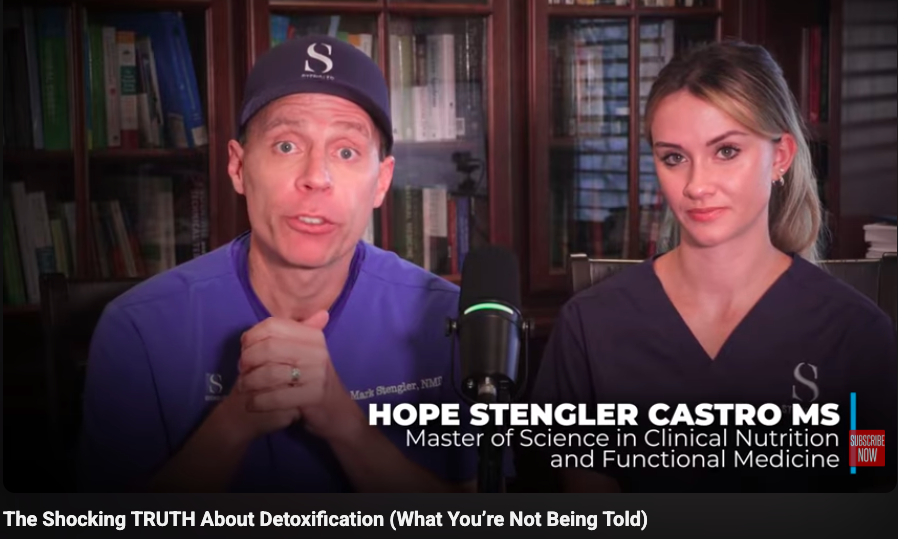

Dr. Stengler: Really, you've got to support detoxification every day of the week, because you've got to get ahead of the curve and prevent these toxins from building up in the body.
Hope Stengler Castro: If you're feeling some symptoms that you think could be related to a buildup of toxins, maybe start eliminating things in your everyday life — maybe start using the air purifier, stop drinking out of bottled water and plastic, change your coffee brand, change your meal containers, and see if there's a difference within a couple of months. Those are the things where you're getting the toxins, and it's not expensive to change it.
Dr. Stengler: Detoxification — what is it? What does it really mean? In this video, we're going to cover what detoxification is, the essence of why you need to detox, the main players in the body for detoxification, and what you need to do nutritionally to detoxify. We live in a toxic world, and yes, we have to learn how to detoxify. I'm Dr. Mark Stengler, a naturopathic medical doctor. I've been in practice for over 30 years and written 20 books on nutrition and functional health. And here I have Hope Stengler Castro — yes, we are related. She has a master's degree in functional medicine and human clinical nutrition, a great combination to have. We both work at the Stengler Center for Integrative Medicine, along with Dr. Angela, my wife, and Hope is our daughter.
Dr. Stengler: This is a very important topic, Hope, because I've seen research showing — and I've talked about this in some of my books — that we have over 100,000 man-made chemicals in our environment. Most of these chemicals don't even have good studies on them; they shouldn't even be in our environment. People are exposed to them all the time in the air, the water, the cosmetics they use, and the medications they take. You can't be healthy if you have toxicity in the body. For the viewers out there, what would you say detoxification really means?
Hope Stengler Castro: A lot of younger people, especially around my age, early-to-mid 20s, don't fully understand that detox is not something you need to do — your body already does it every single day. We're harming our bodies every day with different cosmetics, foods that are not organic, added hormones, toxins in the air, even air fresheners in our house, plastics, microwaved plastics. A lot of people don't understand that it's not just juice cleanses and fasts that fix that. It's not a short-term thing — it's an ongoing natural process that the body performs every single day.
Dr. Stengler: When you look at detoxification, here's the good news: the body has an intricate design to eliminate toxins. So if we work with that design, you can detoxify. A lot of people do detoxification programs, which isn't bad and can be helpful depending on how you're doing it. But the body is designed so that your cells and organs are detoxifying every second of the day. We have special organelles and detoxification systems within cells. People always think of the liver and kidneys — and yes, they're major organs of detoxification — but in the cells themselves, we have special organelles that help with detoxification. So what we want to talk about today is how we best support that process.
Hope Stengler Castro: There's just a misunderstanding that detox is something we need to do to help and support the body, because it's already doing it — but we're harming the body by thinking we're fixing things by drinking juice or not eating for a couple hours a day, while we still have all of these chemicals in our bodies and do these daily things that can harm us without even realizing it.
Dr. Stengler: At the deepest level, how do these toxins affect people? It depends what the toxin is — some are much more damaging than others. If you have high levels of lead in your body compared to high levels of some water-soluble chemical you've been exposed to briefly, there can be big differences in the harm. But there are so many of them — that is the key. When we test people at the clinic, we do an environmental urine test where we screen for pesticides, plasticizers, and BPA, and we check for toxic metals too — lead, mercury, arsenic, cadmium, aluminum. Let's face it, the average person we test has multiple toxin levels in their body, usually more than just mild levels. We check mycotoxins too — mold toxins people get from their food supply, like from grains, nuts, seeds, and coffee. Coffee is a big one.
Hope Stengler Castro: The thing about it is we do have the technology to test for these toxins — the levels they're at and which ones are more dangerous and serious. So people can use this technology.
Dr. Stengler: And one of the things patients like is that it motivates them to take action. When you see high levels of lead, mercury, mycotoxins, or glyphosate (known as Roundup) — high levels, say, with certain types of cancers, and pesticides with Parkinson's disease — it does motivate people to take action. The first thing we should talk about is that it's one thing to detox, but a step before that, you've got to, as best you can, avoid the toxins to begin with. What are your thoughts on that for the viewers?
Hope Stengler Castro: The biggest thing, I think, is to try to eat as much organic produce as possible. With spraying of pesticides and different chemicals, we're eating that food, digesting it, and it builds up — like you've seen on those tests. Also, avoiding heating food in plastic in the microwave, because of all the studies coming out on microplastics. People are heating up their leftovers; it's cheaper to buy plastic than glass containers, but it's not cheaper in the long run.
Dr. Stengler: You point out a major category I forgot in the introduction — microplastics. Now we're seeing them in people's blood vessels, brains, and hearts. It's a sad thing where people were eating healthier and exercising, making their own food at home, and then you find out they're getting microplastics from the container they're storing their healthy food in. Tell the viewers what we've moved over to, because we prepare our meals for the day at the clinic.
Hope Stengler Castro: We use glass containers. No more plastic, no more bags — even pre-made food in bags, microwavable organic rice and things like that, you just want to take them out of the plastic and put them in a glass container. There's no reason to be ingesting that if you don't have to. And the plastic water bottles — even just testing your water to see how good the quality is. Try to stay away from plastic water bottles; bring your own filtered water from home.
Dr. Stengler: We have water filtration systems at the clinic and in the home. Nowadays you have to have a water filtration system — it's imperative. For water containers, focus on stainless steel, ceramic, and glass, because now they've found other bisphenols beyond BPA. People heard about BPA, and it's not in the bottles anymore, but it's still in the environment, and you still have other chemicals in the plastic. And water bottles left out in the heat — if you're at the beach, they get hot and then you're drinking all that plastic. If you're on a trip and getting it once in a while, it's not a problem, but for people doing it day after day, these toxins accumulate. So water is critical, the food — eating more organic, with tons of studies on reducing pesticide exposure — and then there's the air.
Dr. Stengler: I've written about studies where people who live in a city near a bus route are exposed to so many more chemicals and have respiratory and cognitive problems. It's difficult for some people to avoid air pollution, so you've got to do the best you can. As we're sitting here, we've got an air filter, and we have one at the clinic and in our bedrooms at home.
Hope Stengler Castro: Or in the workplace too. Some people can't help it, but it's good to be aware, and to realize if you're having health issues, maybe it has to do with the environment you're working in — heavy metals, pollution, things of that sort.
Dr. Stengler: It's amazing — here in the San Diego area, the number of patients we get with high levels of mycotoxins, mold toxins showing up in their urine samples. We see it from buildings, homes, and workplaces. Those can be the more serious ones, especially black-mold-related, but we see a lot of people with toxins from their food supply. In more recent times, we've been guiding patients, because everyone loves their coffee, and we're finding a lot of people getting high levels of mold from their coffee.
Hope Stengler Castro: Low-acidic, low-mold, organic whole beans, not already ground, so it's the most fresh. If you go out to drink a coffee, it's going to be in a plastic cup — that's inevitable, and once in a while it's not going to hurt; you should still enjoy it. But don't make it a daily habit, because then you're probably having mold from the coffee at a brand store, plus that plastic cup where the hot espresso was brewing into it, so we don't know how many microplastics got into that either.
Dr. Stengler: Let's get more into diet. Obviously, organic foods — many more stores carry these products now. It's come to light that these ultra-processed foods, with artificial dyes, colorings, and preservatives, can definitely affect mood, memory and focus, skin health, and cause digestive problems, depending on how sensitive the person is. The average person is eating out a lot and getting a lot of these chemicals.
Hope Stengler Castro: Or taking Tylenol or Advil, which is not a bad thing, but multiple times a week for some headache — there are so many other natural alternatives, but people are used to it. It's good to be informed of what else is out there.
Dr. Stengler: Now let's get into some of the foods. There are many healthy foods, but there are foods more well-studied for detoxification. Tell us a bit about the cruciferous vegetables — they have a lot of research.
Hope Stengler Castro: Your favorite is the cruciferous vegetables every single lunch. We try to throw kale in there, broccoli, carrots, Brussels sprouts, steamed or cooked with olive oil, not on too high of heat — we don't want to kill all the good compounds by cooking it too much.
Dr. Stengler: Cruciferous vegetables like broccoli, cauliflower, bok choy, kale, and Brussels sprouts have very unique studies showing they assist the detoxification pathways in the liver and kidneys — they help the body break down compounds. One of their unique benefits is they can boost glutathione levels and enzymes related to glutathione, which is a major antioxidant and detoxifier in the cells of the body. But the average American is not consuming cruciferous vegetables on a regular basis. We also have the allium vegetables — garlic and onions.
Hope Stengler Castro: Garlic is really easy to use as a season enhancer; you can add it to pretty much any meal. Onions, grilled or boiled, are great additions. They're really easy to cook — you don't need to be a chef at all. It's a great addition to your meal for a healthy detox.
Dr. Stengler: One of the key things with detoxification is that the average American doesn't come anywhere near meeting the fiber requirements on a given day. A lot of people are getting like 5 grams of fiber, and you should be getting 25 to 40 grams a day. You'll get most of that in salads, vegetables, fruit, nuts, seeds, and beans. If you don't get enough fiber, especially the insoluble fiber that carries the fecal waste out of the colon, you have inefficient bowel elimination. We now know you can reabsorb certain bacteria from the colon back into the bloodstream, which is why in holistic integrative medicine, regular bowel movements are a big thing. We get some patients who tell us they have one to two bowel movements a week, and their general provider tells them it's not a problem. It's not going to kill you immediately, but it is setting you up for health problems.
Hope Stengler Castro: How are they detoxing efficiently if they're not getting anything out?
Dr. Stengler: They can't be. We often recommend things that support liver detoxification, because the liver is so important, and most of what we recommend for the liver also helps the kidneys. Besides the cruciferous vegetables and leafy greens like spinach and romaine, which give you fiber and different nutrients, we sometimes put patients on supplements that help liver detoxification more, like milk thistle, artichoke extract (artichoke is another good food), and dandelion root. These work in part by stimulating the production and release of bile, and bile carries toxins out from the liver and gallbladder into the GI tract so you can eliminate them. What about high-quality protein sources?
Hope Stengler Castro: We focus a lot on getting wild-caught salmon, trying to stay away from the frozen or farmed kind, and more of the lean meats — chicken breast, ground turkey, maybe tilapia or halibut. Once in a while, some ground beef low in fat, but we try to make that more of an occasional meal.
Dr. Stengler: What we've really focused on in the last couple of years is the way we cook the proteins. You're the master cook — tell them how we're restricting the grilling, because we form cancerous compounds when we grill proteins and meats.
Hope Stengler Castro: We try to do a lot of the air fryer, lower heat, and then olive oil on the pan, again low heat. We don't want to kill any of those good compounds in the olive oil or the food.
Dr. Stengler: We've transitioned a lot to the air fryer. You can bake too, but our meals aren't large, so the air fryer works well. People are drinking coffee, and hopefully purified water, but drinking the right teas can really support detoxification. There are a ton of studies on green tea — it has the most numerous studies because it has a unique effect of supporting the detox pathways. One of its benefits, probably what helps prevent cancer and reduce cancer risk, is its ability to improve detoxification, and when you get bad toxins out of the body that cause DNA damage, that can have a cancer-protective effect.
Hope Stengler Castro: Definitely try to do organic tea as much as possible. I like green tea.
Dr. Stengler: I've seen a lot of studies on how regular, non-organic teas are loaded with heavy metals and bad bacteria, so the organic, especially for teas, is highly recommended — you've got to go organic.
Hope Stengler Castro: And try to get loose-leaf tea as well, because of the microplastics. It's hard to stay away from them, but they sell loose-leaf tea now that you can steep on your own at home, so if you're able to, that is the best, or at least get organic. I like jasmine green tea, black tea if you need a little caffeine. You can get rooibos tea, or chicory — all really good non-coffee alternatives.
Dr. Stengler: We have organic teas and try to get the loose-leaf, but it's hard to get all of them loose-leaf organic, so when we use tea bags, we open them up and put them in a little stainless steel container, getting it out of the bag and away from the water. There are other ways to protect yourself — once in a while these things aren't going to hurt you, but time after time. So in a nutshell, your body's detoxifying every second of the day; you've got to restrict the toxins coming in and support your detox organs and cells with proper nutrition, doing your best with air and water purification. What are some of the changes patients report within even a few weeks to a month or two when they make these basic changes?
Hope Stengler Castro: A trend I've seen is energy levels going up, fatigue going down, and better mood — and these people don't even realize they didn't have good mood or didn't know it was possible to be more energetic, because this has been their normal for so long, until they pinpoint what's been driving these processes. And their bowels start to regulate, their digestion improves.
Dr. Stengler: The big one a lot of women report — what about the skin?
Hope Stengler Castro: Healthier skin, definitely brighter and clearer skin, acne improves, and maybe even healthier hair too. A lot of women are very self-conscious about their hair, and a lot of women do lose hair, so that's a big one they report as well.
Dr. Stengler: Basically, everyone should be working on their detoxification. These detoxification protocols — which we do depending on what lab tests show, where you're very intense for 3 days, a week, or two weeks — are important, but really you've got to support detoxification every day of the week to get ahead of the curve and prevent toxins from building up.
Hope Stengler Castro: And if you're feeling symptoms that could be related to a buildup of toxins, maybe start eliminating things in your everyday life — start using an air purifier, stop drinking out of bottled water and plastic, change your coffee brand, change your meal containers, and see if there's a difference within a couple of months. You've got to do those basic things, because those are the main reasons people are getting toxins on a consistent basis. It's not expensive to change it.
Dr. Stengler: In any event, good talking with you and the viewers out there. If you liked this video, hit the like button and make sure to subscribe to our YouTube channel. We look forward to talking to you more about detoxification supplements and other natural ways to help you detoxify and feel better.
Daily Detox Done Right: Why You Need to Clean Up Your Environment and Diet
Feeling tired, foggy, or inflamed—and not sure why?
In this powerful and practical video, Dr. Mark Stengler and Hope Stengler Castro explain why detoxification isn’t a fad, it’s a vital daily process—and how everyday exposures to plastic, pesticides, cosmetics, and even your coffee brand may be slowing your body down.
Here’s what you’ll learn:
💧 Support your detox organs daily. Clean your inputs. Feel the difference.
CHAPTERS
00:00 What Are Sulfites?
00:52 Sulfites vs. Sulfates Explained
02:10 Internal and External Sources of Sulfites
04:00 Why Sulfite Build-Up Causes Symptoms
05:30 Common Reactions and Sensitivities
06:40 The Role of Sulfite Oxidase and Molybdenum
08:45 Genetic and Heavy Metal Factors
10:20 Supporting Detox and Reducing Exposure
11:40 Final Tips for Managing Sulfite Sensitivity
🔔𝐃𝐨𝐧'𝐭 𝐟𝐨𝐫𝐠𝐞𝐭 𝐭𝐨 𝐬𝐮𝐛𝐬𝐜𝐫𝐢𝐛𝐞 𝐭𝐨 𝐦𝐲 𝐜𝐡𝐚𝐧𝐧𝐞𝐥 𝐟𝐨𝐫 𝐦𝐨𝐫𝐞 𝐮𝐩𝐝𝐚𝐭𝐞𝐬.
🔗 Stay Connected With Me.
Facebook: / markstengler Instagram: / markstengler Website: http://drstengler.com/


