
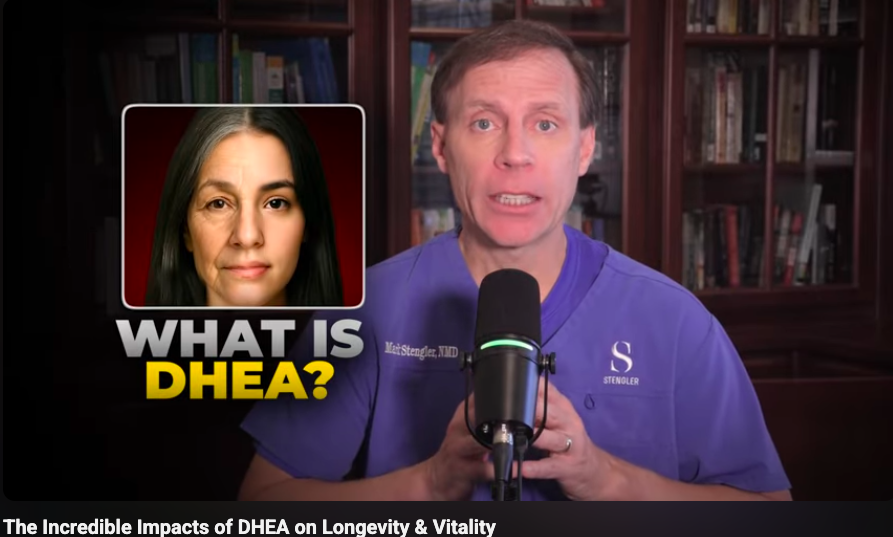

Dr. Stengler: Did you know that DHEA is an anti-aging hormone? In this video, I'm going to review the incredible anti-aging effects of DHEA and what you should know about this adrenal hormone. I'm Dr. Mark Stengler, a naturopathic medical doctor. I've been practicing integrative medicine for over 30 years and I've written 20 books on nutrition and integrative medicine.
DHEA, which stands for dehydroepiandrosterone, is a natural hormone that's critical for good health and vitality. Chronic stress and illness can drive your DHEA levels too low, yet few doctors test for deficient levels, so many people are left to suffer with deficient DHEA. Your adrenal glands produce most of your DHEA; the testes in men, the ovaries in premenopausal women, and the brains of both sexes can produce this critical hormone in smaller amounts. Your body uses cholesterol to form the hormone pregnenolone, which is then converted into DHEA — one reason you should be concerned about suppressing your cholesterol levels too low, as often happens with cholesterol-lowering statin drugs.
As with most hormones, DHEA levels drop over time. By the time you turn 80, your DHEA levels have dropped by up to 90% compared to young adulthood, and as our levels drop, we start to see the effects. DHEA in many ways works as a synergistic twin to the other stress hormone, cortisol; it helps the body adapt to physical, mental, and emotional stress more efficiently. Studies show that declining DHEA levels are linked to allergies, inflammation, fatigue, autoimmune issues, sexual dysfunction, infections, insomnia, cognitive decline, cardiovascular disease, bone loss, depression, and even cancer.
Age-defying DHEA is both beneficial and safe, and proper hormone balance is critical to good health, which is why testing is so important. Over 30 years ago, when I had finished naturopathic medical school, I tested my own DHEA levels and they were quite low and deficient, so I took DHEA for a period and really felt the rejuvenating effects. I see many patients whose DHEA levels are low, suboptimal, or outright deficient, and correcting it makes a huge difference in their health and vitality. Many of my patients have been made to feel concerned by their conventional doctors about using DHEA — told it's a hormone and dangerous, that it can cause hair loss, acne, and even cancer. But DHEA is available over the counter, and even though the FDA regulates dietary supplements, they don't have a problem with DHEA being over the counter, because the research shows it's extremely safe. That said, if you have a medical condition or a history of cancer, run anything you take by your doctor.
DHEA has many specific effects: it supports bone health, helps libido, reduces inflammation, helps energy levels, and can help cognitive function. One double-blind study published in the Proceedings of the National Academy of Sciences looked at daily DHEA supplementation in 280 healthy volunteers, women and men ages 60 to 79, given 50 milligrams of DHEA or a placebo daily for a year. The authors noted no potentially harmful accumulation of DHEA and active steroids, and established that DHEA supplementation normalized some effects of aging — which is why it's considered one of the key anti-aging hormones. Specifically, they found improved bone density in women over 70, improved libido, and healthier skin. The researchers noted that low concentrations of DHEA are associated with immunosenescence (the breakdown of the immune system as people age), physical frailty, decline in muscle mass, increased mortality, loss of sleep, diminished feelings of well-being, and impaired ability to cope, and occur in several common diseases including cancer, atherosclerosis, high blood pressure, diabetes, osteoporosis, and Alzheimer's disease.
In recent years, several studies have demonstrated that DHEA has a protective effect against heart disease. One study published in the Journal of the American College of Cardiology found that low blood levels of DHEA were a significant risk for major coronary heart disease in elderly men. In the journal Stroke, researchers from Brigham and Women's Hospital and the Harvard School of Public Health reported an association between lower levels of DHEA and a greater risk of stroke in older women — those whose DHEA levels were among the lowest 25% had a 33% higher risk of having a stroke.
We often recommend DHEA for cognitive function and mood, especially for patients with low levels. DHEA supports the production and functioning of the neurotransmitters in your brain, the chemicals that affect memory and mood; in fact, the concentration of DHEA in your central nervous system is much higher than in your blood. DHEA has also been found to have regenerative properties on brain tissues. People with Alzheimer's disease have low levels of certain nerve-protecting growth factors, but DHEA is able to help shield delicate brain tissues by preserving these important growth factors, including IGF-1 (insulin-like growth factor 1), VEGF (vascular endothelial growth factor), and TGF-beta (transforming growth factor beta). In addition, DHEA lowers levels of the brain-cell-damaging stress hormone cortisol, and several studies have confirmed that DHEA supplementation improves cognitive function. People with low DHEA levels are more susceptible to anxiety and depression, and studies have shown DHEA supplements can help ease both conditions.
DHEA is also linked to strong bones and balanced blood sugar levels. Many people have osteopenia (a loss of bone mass) or osteoporosis (more severe bone loss), and while many factors and hormones are involved, this includes low levels of DHEA, which is critical to bone metabolism — studies with senior women have shown DHEA supplementation improves bone mineral density within 1 to 2 years. Another condition where you should consider DHEA, especially if your levels are low, is diabetes; diabetics are often found to have low levels, and in one study, an astounding 77% of men with type 2 diabetes had low levels. DHEA plays an important role in improving insulin resistance, allowing cells to take up glucose more effectively. DHEA is also important for a strong immune system — when you suffer chronic stress, cortisol skyrockets and the immune system can become suppressed, but healthy DHEA levels can counterbalance this. There's even some research suggesting DHEA could play a role in fighting autoimmune conditions, especially lupus.
Healthy hormone levels support a healthy sex life. Similar to testosterone, DHEA is vital for healthy sexual function in both men and women and improves sexual desire in both sexes. In one study, 50 milligrams of DHEA improved sexual function in men without any adverse effects on their PSA level, which represents prostate health, and in postmenopausal women, vaginal DHEA suppositories have been shown to help with vaginal atrophy and dryness. Lastly, more than a dozen studies suggest that declining levels of DHEA are associated with a greater likelihood of death from various causes — in other words, DHEA supports so many systems that a major deficiency can contribute to a number of diseases.
As with all hormones, I recommend you have your levels tested before you take any hormone, including DHEA. You can do it through blood levels — DHEA sulfate blood levels, best done before 9:00 in the morning — saliva DHEA levels, which are very accurate and also done in the morning, or urine tests. After you've been on DHEA for 2 to 3 months, check your levels, make sure you're at a good range, and then you know the dose is proper for you. I hope you enjoyed this video. If you have more questions on hormone balance or anything to do with integrative medicine, check out other videos on my YouTube channel. If you liked this video, make sure you hit the like button. We'll see you soon.
Discover the Powerful Anti-Aging Hormone Most Doctors Overlook
DHEA is one of the most important yet under-discussed hormones in your body—and its decline with age can impact everything from your energy levels to your immune function and even your brain.
In this enlightening video, Dr. Mark Stengler explains:
Whether you’re dealing with fatigue, brain fog, poor libido, or just want to age with vitality, this video will help you understand how DHEA may be the missing link in your health.
CHAPTERS
00:00 What DHEA Is and Why It’s Considered Anti-Aging
01:05 How DHEA Declines With Age
01:43 Is DHEA Safe? What Research Really Shows
02:08 Dr. Stengler’s Personal Experience With Low DHEA
02:24 Common Myths About DHEA and Safety Concerns
02:49 Key Benefits: Energy, Libido, Cognition & Inflammation
03:03 Major Study: DHEA Supplementation in Older Adults
03:38 How DHEA Supports Immune Function & Aging
04:17 DHEA and Heart Disease, Stroke & Longevity
05:00 DHEA’s Impact on Brain Function, Mood & Stress
06:14 DHEA, Bone Density & Blood Sugar Support
07:02 DHEA and the Immune System Under Chronic Stress
07:18 Autoimmune Research: DHEA & Lupus
07:29 DHEA and Sexual Function in Men & Women
08:13 The Best Ways to Test Your DHEA Levels
🔔𝐃𝐨𝐧'𝐭 𝐟𝐨𝐫𝐠𝐞𝐭 𝐭𝐨 𝐬𝐮𝐛𝐬𝐜𝐫𝐢𝐛𝐞 𝐭𝐨 𝐦𝐲 𝐜𝐡𝐚𝐧𝐧𝐞𝐥 𝐟𝐨𝐫 𝐦𝐨𝐫𝐞 𝐮𝐩𝐝𝐚𝐭𝐞𝐬.
🔗 Stay Connected With Me.
Facebook: / markstengler Instagram: / markstengler Website: http://drstengler.com/


