
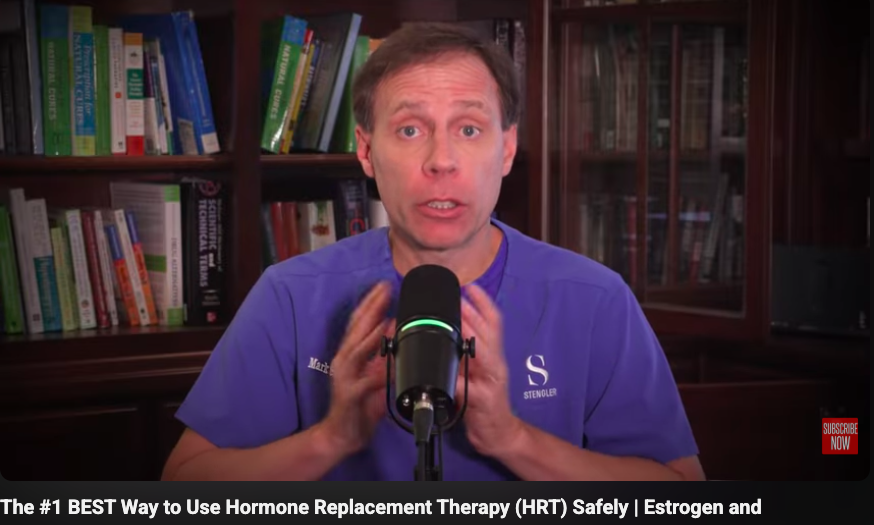

Dr. Stengler: With combined therapy — using estrogen combined with synthetic progesterone — there was a small increase in breast cancer incidence detectable after about 3 to 5 years of use. The risk goes down once you stop it. However, this risk really is mainly with medroxyprogesterone, a synthetic form, not a bioidentical form of progesterone. The Menopause Society notes that the risk of breast cancer related to hormone therapy is low, with estimates indicating a rare occurrence — less than one additional case per 1,000 women per year of hormone therapy use, or three additional cases per 1,000 women when used for five years with the synthetic progesterone, medroxyprogesterone acetate, which none of us doctors in holistic medicine ever recommend.
I'm Dr. Mark Stengler. I've researched and written 20 books on nutrition and functional medicine, including the topic of menopause. So let's dive in. Estrogens are produced in several locations in the female body, with the primary sites changing before and after menopause. Before menopause, in the reproductive years, the ovaries are the main source of estrogen — specifically, the most potent estrogen, estradiol. But there are other sites in the premenopausal years: the corpus luteum, which is released after ovulation; the adrenal glands; fat cells and adipose tissue; the placenta during pregnancy; and other sites such as the liver, heart, skin, and brain, which produce small amounts.
After menopause, the ovaries decrease their estrogen production significantly, but the body continues to produce small amounts of a weaker form of estrogen, primarily known as estrone. This is mainly produced throughout the body from other hormones called androgens, produced by the adrenal glands, which are converted into estrogen by an enzyme called aromatase. The main sites for estrogen production after menopause are the fat cells, or adipose tissue, which contain the aromatase enzyme, and the adrenal glands, while the ovaries continue to produce small amounts. Hormone therapy is about replacing the estrogen and progesterone your ovaries produce less of during menopause, to relieve your symptoms and protect your health.
There are really three types of estrogen — estradiol, estrone, and estriol. And there are two main ways estrogen is used: estrogen-only, which some doctors use when women have had their uterus removed (a hysterectomy), and the more common estrogen-plus-progesterone therapy. The progesterone protects the uterus from building up the lining, which can lead to endometrial or uterine cancer. The form matters — topical, capsules, pills, or vaginal creams.
Progesterone is also a steroid hormone produced in several locations, with production sites shifting depending on reproductive stage. During the menstrual cycle, the primary production site is the corpus luteum, a temporary gland that forms from the ovarian follicle after an egg is released during ovulation, producing high levels of progesterone during the second half of the cycle, the luteal phase. During pregnancy, the corpus luteum continues to secrete progesterone for about the first 10 weeks; after the first trimester, around 10 to 12 weeks, the placenta takes over as the primary source for the remainder of the pregnancy. There are other sites: a small amount is produced by the adrenal cortex in both men and women, and the ovaries themselves produce progesterone in small quantities. During and after menopause, a woman's body significantly reduces its production of progesterone.
There are different types of progesterone replacement, just like estrogen — topical, pills, vaginal creams, and suppositories. However, for women on estrogen replacement therapy, the most well-studied form is oral progesterone, such as in capsule form. Progesterone prevents the buildup of the uterine lining, the endometrium, preventing abnormal vaginal bleeding and uterine cancer when women are on estrogen replacement therapy. Some doctors do not recommend progesterone if you've had a hysterectomy, but I think that's a mistake, because you have progesterone receptors in your blood vessels, bones, brain, and breasts — it's used by the body to maintain balance with estrogen.
Hormone therapy is considered the gold standard because of its strong and proven benefits in menopause. The following benefits, as published in the journal Menopause, reflect the North American Menopause Society statement on hormone replacement. I don't agree with everything the Menopause Society says, but they do have a good literature review. They recommend hormone replacement therapy for symptom relief — it's very effective for hot flashes and night sweats when you give the right doses and types. It's also highly effective for genitourinary syndrome of menopause: vaginal dryness, burning, painful intercourse, and even recurring urinary tract infections, for which a woman could just use low-dose vaginal estrogen.
There are long-term health protection benefits. For bone health, hormone replacement is shown to prevent bone loss and reduce fracture risk in postmenopausal women, more specifically the estrogen, but the benefit is lost quickly if you stop. For diabetes, studies show hormone replacement significantly reduces the incidence of new-onset type 2 diabetes for women using both estrogen-only and in combination with progesterone. For joint pain, estrogen replacement reduces joint pain and stiffness. There are additional benefits: it helps with insomnia; skin health such as thickness, elasticity, and collagen production when given at menopause; eye health, possibly decreasing the risk of macular degeneration and open-angle glaucoma in Black women; it can decrease dizziness or vertigo and may improve postural balance; and when estrogen is combined with exercise, it can improve muscle mass and strength.
How about weight? Hormone replacement has been shown to help with abdominal adipose accumulation and weight gain, though in the studies the effect is small. Cognitive function: small clinical trials support estrogen therapy for cognitive benefits when initiated immediately after a hysterectomy with both ovaries removed, and three large randomized controlled trials demonstrated neutral effects on cognitive function when used in the postmenopausal period, so there don't seem to be problems — however, synthetic progesterone may increase the risk of dementia. Depression: there's some evidence estrogen has an antidepressant effect similar to antidepressant drugs when given to depressed perimenopausal women, but for postmenopausal women, estrogen has not been shown to help depression. Cardiovascular disease: some research shows estrogen reduces the risk of coronary heart disease, especially if you're younger than 60 or take it within 10 years of menopause onset — this is the so-called golden window.
The Menopause Society's main takeaway is that risks are rare with estrogen replacement therapy and highly dependent on when you start therapy — often called the timing hypothesis. For healthy women younger than 60, or within 10 years of their last menstrual period, the ratio of benefits to risk is considerably favorable, and the advantages of symptom relief and bone protection generally outweigh the potential risks. For women who initiate hormone therapy more than 10 years after menopause or who are older than 60, the benefit-risk ratio is less favorable. It can still be helpful, but you do get some very mild increased risks in things like coronary heart disease, stroke, and blood clots — although this tends to be in women not using topical or transdermal estrogen.
For blood clots and stroke, the risk is elevated, especially when therapy is started later in life. However, you can reduce this risk quite a lot by using transdermal or topical patches, gels, and creams, because blood clots are more associated with the pill or oral form of estrogen. As for breast cancer, the risk depends on the type of formulation. For estrogen-only therapy, long-term follow-up from the largest study, the Women's Health Initiative, actually showed a reduced incidence of breast cancer over time for women using estrogen alone. With combined therapy using synthetic progesterone, there was a small increase in breast cancer incidence detectable after about 3 to 5 years of use, with the risk going down once you stop — but this risk is mainly with medroxyprogesterone, a synthetic form, not a bioidentical form. Endometrial cancer can occur with unopposed systemic estrogen, which is why it's so important to take bioidentical progesterone, especially oral, to protect the uterine lining; low-dose vaginal estrogen does not appear to increase endometrial cancer risk.
When we use hormones with women, I base it on their symptoms, age, general health, and lab tests — we want to be very personalized. For women who experience premature menopause (before age 40) or early menopause (before age 45), estrogen replacement therapy, and I'd add progesterone as well, is strongly recommended, because these women face an elevated risk of heart disease, bone loss, and other issues, including early mortality. Hormone therapy is advised at least until the natural average age of menopause, around age 52, for these premature cases to mitigate the long-term health risks of estrogen deficiency. Treatment must be individualized — if you don't have premature menopause, we want to get you on the amounts you need to control your symptoms, at the lowest dose necessary, to improve your quality of life.
The Menopause Society notes that the benefits of hormone therapy usually outweigh the risks for healthy women with bothersome menopause symptoms who are younger than 60, or within 10 years of menopause onset. What about women over 60 who've been on hormone replacement for 10 years already? It can still be used. Long-term use can be considered in healthy women at low risk of cardiovascular disease and breast cancer who continue to have hot flashes and night sweats (vasomotor symptoms), or women at elevated risk of fracture for whom other therapies aren't appropriate. Hormone therapy does not need to be routinely discontinued — women older than 60 or 65 need to talk with their doctor, look at their risk factors, and be monitored with proper breast exams, physical exams, and lab work. I do have quite a few women over 60 still on hormone replacement therapy; it helps manage their symptoms, mood, skin and hair health, joint health, energy levels, and quality of life.
You want to work with a doctor who has a lot of experience using hormone replacement, and look for doctors trained in bioidentical hormones. You can get bioidentical hormones from regular pharmacies — there are estrogen patches and gels that are bioidentical, and bioidentical progesterone. However, I like to rely more on compounding pharmacies, because there are a lot of different options: different routes of administration, and you can be very precise for the patient, making small changes in the dosages of estrogen and progesterone and dialing it in more precisely than with hormones from regular pharmacies. Both systems can be used; you just want to be very personalized, make sure they're feeling well, their lab tests look good, and they're monitored. For a lot of women, hormone replacement not only helps the menopausal symptoms but greatly enhances their quality of life. I hope you liked this video. I've got other videos on hormone balance for both women and men. Make sure to like the video and subscribe — I'll see you in the next video.
Are You Using the Right Kind of Progesterone? Your Health Could Depend on It.
Many women are told hormone therapy is risky—but they’re not told why. In this eye-opening video, Dr. Mark Stengler breaks down:
✅ The real breast cancer risks tied to synthetic progesterone (like medroxyprogesterone)
✅ Why bioidentical hormones are a safer, science-backed alternative
✅ The truth about hormone therapy and conditions like hot flashes, bone loss, and early menopause
✅ How to reduce risk of stroke and blood clots with topical estrogen instead of pills
✅ The essential role of progesterone—even after hysterectomy
You’ll also learn about:
• The “Golden Window” for starting hormone therapy safely
• The role of custom-compounded bioidentical hormones for personalized care
• What the North American Menopause Society really says about risks and benefits
Whether you're considering HRT or already using it, this is essential info your OB-GYN might not be sharing.
👉 Watch now to get empowered with the facts—and take control of your health with confidence.
CHAPTERS
00:00 Breast Cancer Risk: Synthetic vs Bioidentical Progesterone
00:50 Where Estrogen Is Made Before & After Menopause
02:07 Why Hormone Therapy Matters in Menopause
03:34 Progesterone Production Through Life
04:47 The Best Form of Progesterone for Protection
05:33 Proven Benefits of Hormone Replacement Therapy
06:52 Beyond Hot Flashes: Extra Health Benefits
07:29 Timing Hormone Therapy for Safety
08:39 Blood Clot & Stroke Risk: Topical vs Oral Estrogen
09:14 Understanding Breast Cancer Risk in Depth
10:03 Who Should Strongly Consider Hormone Therapy
11:05 Long-Term Use After Age 60
12:03 Bioidentical Options & Personalized Hormone Care
🔔𝐃𝐨𝐧'𝐭 𝐟𝐨𝐫𝐠𝐞𝐭 𝐭𝐨 𝐬𝐮𝐛𝐬𝐜𝐫𝐢𝐛𝐞 𝐭𝐨 𝐦𝐲 𝐜𝐡𝐚𝐧𝐧𝐞𝐥 𝐟𝐨𝐫 𝐦𝐨𝐫𝐞 𝐮𝐩𝐝𝐚𝐭𝐞𝐬.
🔗 Stay Connected With Me.Facebook: / markstengler Instagram: / markstengler Website: http://drstengler.com/


